Translate

Showing posts with label money. Show all posts

Thursday, April 9, 2026

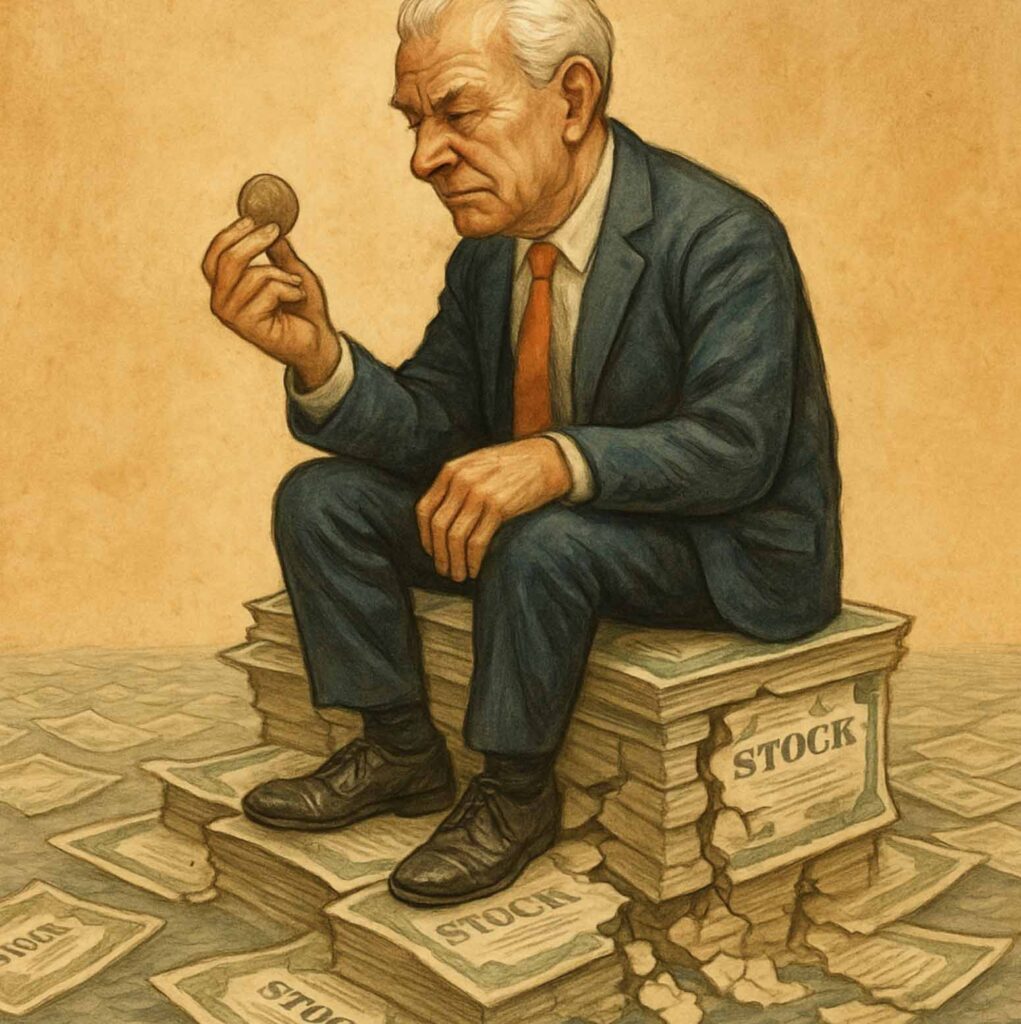
PAPER BILLIONAIRES: Why the Rich Aren’t as Liquid as You Think..

The Illusion of Billionaire Wealth

 At first glance, headlines about billionaire's sound like bulletins from a rich-people lottery: “Elon Musk Worth $500 Billion!” or “Mark Zuckerberg Tops $250 Billion!” It’s tempting to assume such fortunes translate into cash in the bank. In reality, however, most of the ultra-rich’s wealth is not stashed in vaults or bank accounts – it exists as paper wealth tied up in stocks, equity and other illiquid assets. A Tesla share price plunge, a tech stock correction or an economic downturn can instantly vaporize tens of billions of dollars from these net worth tallies. Modern billionaires often hold only a tiny fraction of their reported fortunes as liquid cash or spendable assets. Instead, their fortunes rise and fall with company valuations, and they typically rely on borrowing (pledging shares as collateral) rather than selling stock to get money.

This article digs deep into how and why billionaire fortunes are largely “on paper,” using real-world examples and data. We’ll look at the composition of wealthy investors’ portfolios, the dramatic swings in headline net worth, and the creative financing hacks the super-rich use to access cash without selling their equity. By the end, you’ll see that the richest people aren’t exactly swimming in cash – their money is mostly on tap, not in hand.

The Illusion of Billionaire Wealth

When Elon Musk’s fortune briefly crossed $500 billion in late 2025, it made international news. But that figure was based almost entirely on stock prices, not actual cash. In Musk’s case, his Tesla shares accounted for by far the largest slice of his net worth. One news analysis noted that Musk owns about 12% of Tesla – a company worth over $1.5 trillion – and that stake is where “most of Musk’s wealth lies”. In other words, rather than a $500B cash pile, Musk’s net worth was essentially 12% of Tesla’s market value (plus stakes in SpaceX and other ventures).

The same pattern holds for other tech titans. Facebook’s (Meta’s) Mark Zuckerberg, for example, has over 90% of his wealth invested in Meta stock. Forbes estimates Zuckerberg owns roughly 13% of Meta’s shares, making that stake worth about $255 billion – which is about 96% of his $266 billion fortune. Jeff Bezos likewise derives about 90% of his wealth from Amazon stock. These holdings are theoretically convertible to cash – they are “liquid” in that they trade on public markets – but only in the sense that some shares can be sold at current market prices. If these billionaires tried to liquidate their entire positions, they couldn’t simply hoard all that cash without shattering the market price.

Consider Bezos’s case: his 9% Amazon stake is worth about $212 billion. That sounds “liquid,” but financial analysts warn that dumping such a vast share would tank the stock. As one report puts it, “if Bezos tried to convert $212.4 billion worth of his own company’s shares, the market reaction would likely be mass panic-selling that tanked the price of the very stock that makes up nine-tenths of Bezos’ own wealth.”. In practice, billionaires must be careful selling large chunks of their holdings. A fire sale would hurt not only the company but themselves, since the value of their remaining shares would plunge.

In short, billionaire net worth numbers are mostly paper: they reflect the current market valuation of shares and other assets, not cash-on-hand. To illustrate with a couple of snapshots:

  • Elon Musk (Tesla, SpaceX, etc.) – In October 2025 Musk briefly became the first person ever with a $500 billion net worth. That was after Tesla’s share price surge. But as investors know, Tesla stock can swing wildly. At the end of 2021, Musk’s net worth peaked near $338B (mostly Tesla-based), and then Tesla’s price plunged 65% through 2022 – wiping out over $200B of Musk’s fortune in a year. By early 2023, Musk was no longer anywhere near $500B. This underscores that a billionaire’s wealth can shoot up or collapse almost overnight with the stock market.
  • Mark Zuckerberg (Meta/Facebook) – Meta’s stock has also been volatile. At its peak in 2021, Zuckerberg’s 13% stake made him one of the world’s richest, but a prolonged market slump and company challenges sent Meta shares lower. His net worth can rise or fall by tens of billions as stock prices change. (For example, on Sept 21, 2025, 13% of Meta was worth $255B, but on April 21, 2025 that same stake was just $159B, a 37% swing in months.)

These examples show the flipside of the headline “richest person” stories. Yes, their fortunes can be enormous on paper – but that fortune is riding on stock tickers. Billionaires generally do not have tens of billions in a bank account or under their mattress. Instead, they own stakes in companies, real estate, art, yachts and other assets. Most of those assets (especially company shares) are illiquid: they can’t easily be turned into cash at full value without affecting the market.

Where Do Billionaires Keep Their Money?

To understand billionaire liquidity, it helps to compare with a typical wealthy investor. For example, Bank of America’s “U.S. Trust Survey of Affluent Americans” found that high-net-worth individuals (with $3M+) hold only about 15% of their portfolio in cash or cash equivalents, on average. The rest is in investments like stocks, bonds, business equity, and real assets. Ultra-wealthy billionaires take this to an extreme: surveys and reports consistently show they keep far more than 85% of their wealth in stock and business equity, and often a sizable chunk in hard assets or private holdings.

While there’s no single official breakdown for all billionaires, some data points illustrate the pattern:

  • Public equity: A huge share. Most tech and finance billionaires own large blocks of publicly traded stock – often their own companies. For example, as noted, 90%+ of Bezos’s wealth is in Amazon stock, and about 96% of Zuckerberg’s in Meta. Musk had nearly 80% of his initial fortune in Tesla at times. Even outsiders’ wealth often sits mostly in stocks or bonds. Wealth managers note that the richer someone is, the more of their net worth is tied up in business equity rather than cash.
  • Private businesses: Billionaires often own entire companies or stakes in private firms, and those valuations are also “paper”. For example, Mark Cuban’s wealth rose hugely when Microsoft acquired his private venture. Even though his stake was sizable, he didn’t actually pocket cash until the deal was announced. Similarly, a founder’s stake in a startup means high net worth on paper, but that value is illiquid until and unless the company is sold or goes public.
  • Real estate and collectibles: Many billionaires invest in luxury real estate, art, and other illiquid assets. These can represent significant wealth, but they’re very slow to convert to cash. A mega-mansion or private island might cost hundreds of millions, but selling it at market value can take months or years, and often at a discount. Forbes has noted that for someone like Jeff Bezos, real estate holdings might total a few hundred million (tiny compared to $200B Amazon stake). In short, luxury assets are status symbols and investments, but not sources of quick liquidity.
  • Cash and equivalents: Virtually all surveys and analyses agree that billionaires themselves usually keep very little cash relative to their paper wealth. They don’t leave hundreds of billions idle in a bank account because that’s not an efficient use of capital. Instead, they park money in investments. In fact, the financial press often points out that even the very rich are far less liquid, percentage-wise, than ordinary savers. For example, one account noted that a typical multi-millionaire has about 15% cash, whereas American billionaires almost never hold anywhere near that much in cash.

Putting it simply: Being rich on paper does not mean having cash on hand. If a billionaire’s public holdings tumble, their headline net worth can evaporate without them ever touching their “assets.” Conversely, when stock markets rise, their wealth inflates on paper even though they haven’t earned a penny of profit.

Chart: Ultra-high-net-worth fortunes, 2020–2023. An Oxfam report found that the world’s five richest men saw their combined wealth soar from $340.1 billion in 2020 to $718 billion in 2023. (Numbers in chart are illustrative values of net worth in 2020 vs 2023 for Musk, Arnault, Ellison, Buffett, and Bezos.)

Another way to see this is through recent history. Between 2020 and 2023, the top five richest people on Earth roughly doubled their fortunes, rising from about $340 billion to $718 billion. This dramatic growth was almost entirely stock-driven. As one graphic put it: “the five wealthiest men – and they are all men – more than doubling their fortunes since 2020,” according to Oxfam researchers. For example, Elon Musk’s net worth rocketed from about $24.6B in early 2020 to roughly $180B in 2023 (a 632% jump), largely on Tesla’s surge. In contrast, Jeff Bezos’s wealth barely budged over the same period (holding roughly flat around $113–$114B) despite being the world’s second-richest, since Amazon’s stock didn’t rise as dramatically. These swings underscore the “paper” nature of it all: fortunes climbed or stagnated based on stock market moves, not cash earned.

Riding the Roller Coaster: Volatility of Billionaire Net Worth

“Paper wealth” can disappear as fast as it is gained. A notorious example: Elon Musk’s wealth plunge in 2022–2023. After topping the world rich list for most of 2021, Musk saw Tesla’s stock crash, costing him over $200 billion. A Bloomberg-tracked breakdown showed his net worth falling from $338 billion in November 2021 to around $100–130 billion by late 2022. Musk himself downplayed such swings in company communications, but the effect on his ranking was real – by late 2022 he lost the richest-person crown to Bernard Arnault. In graphic form (below), the collapse is stark: Musk lost more than half of his fortune in just over a year, the biggest one-year wealth loss in history.

Chart: Musk’s fortune collapse. Tesla CEO Elon Musk’s net worth plunged by over $200 billion between late 2021 and late 2022, mainly because Tesla’s stock price fell 65%. Bloomberg reported his $338B peak in Nov 2021 and rapid decline through 2022.

Stock market volatility has similarly dramatic effects for other billionaires. During the tech stock downturn of 2022, Mark Zuckerberg and Bill Gates each lost tens of billions overnight as their companies’ shares sank. Conversely, a booming market can create “overnight” billionaires when a smaller equity stake surges. For instance, Tesla stock’s rally in 2020–2021 made Musk (and some early Tesla investors) far richer without them selling a share. But when that rally reversed, those paper gains shrank again. Unlike salaries or business profits, paper wealth exists only when valuations hold.

It’s not just tech CEOs. Oil and commodity billionaires have seen swings as well. When oil prices collapse, net worths tied to petroleum stocks fall; when a bubble inflates, fortunes puff up. During the pandemic, for example, the richest Americans saw unprecedented percentage swings in wealth: one study found the top 0.1% held as much in unrealized gains as 84% of all Americans. In an accelerating feedback, early 2020s tech breakthroughs (like AI) sent valuations sky-high, then brief market jitters knocked them down. For a billionaire, any significant market move can mean up or down tens of billions, even though their everyday liquidity hasn’t changed at all.

To put it plainly: if Musk’s Tesla shares go up by 10%, his net worth jumps by about $40B; if they drop 10%, he loses $40B on paper. That money never hit his bank – it just reflected market swings. In fact, Musk’s case is striking: as Bloomberg noted, almost all of his wealth is in Tesla stock, and when Tesla plunged 65% in 2022, his fortune collapsed by more than half. His personal cash (or real spendable assets) barely budged; it was the stock value that vaporized.

Liquid Assets vs. Illiquid Holdings

When it comes to spending money, billionaires still have to operate within liquidity constraints. Liquid assets (cash, bank deposits, government bonds) can be quickly spent or accessed. Illiquid assets (private business stakes, real estate, large stock positions) cannot. For most of us, cash and liquid investments are a safety net. For billionaires, liquid reserves tend to be a tiny fraction of the total, precisely because their wealth is parked in things that might be less stable but yield more growth. As one analysis of Jeff Bezos showed, about 90% of his $235B wealth was in Amazon stock, with only a few billion in cash or similar. In fact, Bezos himself was estimated to have only around $12–13B in cash and equivalents, a minuscule portion of his fortune.

Contrast that with average Americans: surveys show even moderately wealthy individuals often keep 10–20% of their portfolio in cash and safe assets, and routinely draw on that for purchases or emergencies. Billionaires, by contrast, might keep only a few percent in cash – just enough for private jet fuel and yacht maintenance. The rest stays invested. This means that if billionaires want large sums of cash, they have to get creative. You can’t simply write a check for $1 billion out of thin air if your net worth is 99% stocks.

The problem is that selling assets quickly would move markets. Suppose Elon Musk wanted to raise $100 billion. He could, in theory, sell about 25 million Tesla shares (at $4,000 each) to get that cash. But 25 million shares is a huge sale – roughly 3–4% of Tesla’s total outstanding shares. Dumping that on the market would flood supply and crash the price. Not only would Musk get less money per share, his remaining stake would also shrink in value. Tesla’s own SEC filings warn of this: if “Elon Musk were forced to sell shares of our common stock… we noted that… such sales could cause our stock price to decline”. In other words, quickly turning paper into cash would be self-defeating.

One high-profile example is when Musk attempted to finance the $44B purchase of Twitter (now X). He needed tens of billions of dollars, so he turned to loans rather than selling Tesla stock outright. As reported in 2022, Musk’s financing package for X involved about $33B of loans against assets, instead of selling most of his Tesla shares. Breakingviews analysts noted that to get $33B one would normally have to sell a huge chunk of Tesla. Instead, Musk sold only modest amounts, because Tesla’s board and banks allowed him to pledge stock as collateral for loans. In fact, filings showed that by mid-2021, Musk had already pledged 88 million Tesla shares as collateral against personal loans – roughly one-quarter of his stake. This leverage gave him cash power while avoiding a massive one-time sale. Ultimately, billionaires have various channels to access cash without outright liquidating all their shares:

  • Margin loans and pledging stock: Many super-rich individuals take out loans using their own stock or assets as collateral. For instance, Larry Ellison of Oracle arranged a huge personal credit line by pledging Oracle stock. In 2014, Ellison secured a $10 billion credit line for personal use – essentially a giant credit card – by putting up 250 million Oracle shares as collateral. (Ellison still owned over 1.1 billion Oracle shares, so he only pledged about 20–25% of his stake.) Effectively, Ellison borrowed against his equity instead of selling it. This kind of “stock loan” is common among billionaires: banks are willing to lend to them because their assets are so valuable, and the loan interest rates are usually low.
  • Borrowing from their own companies: In some cases, founders borrow from their own companies or affiliates. A recent Reuters report revealed Elon Musk took a $1 billion loan from SpaceX in 2023, just as he was buying Twitter. SpaceX (another Musk-led firm) approved a loan backed by Musk’s own SpaceX shares. Musk effectively used his private rocket company as a bank to fund his other ventures. Similarly, if a billionaire has significant cash reserves in a personal holding company or family office, they can tap those indirectly.
  • Margin lines from brokers: Another route is a margin loan from a brokerage, where shares are pledged and one can borrow a percentage (often 50% or so) of their value. For example, activist investor Ryan Cohen has pledged a large fraction of his GameStop stock to obtain a $1B margin loan (so even modestly wealthy people do this). SoftBank famously borrowed against its holding company arm stock. Such loans let billionaires spend money now, repaying later with interest.
  • Private equity and bond issuance: In some cases, very large investors even issue bonds backed by their own stock. For example, a Chinese fintech magnate reportedly sold bonds against his stake in the company, effectively borrowing money tied to his shares. These complex strategies highlight that direct cash isn’t needed to finance big purchases.

These borrowing tactics are sometimes described in media as the “buy, borrow, die” strategy. The idea is: you never sell your stock (so you don’t pay capital gains taxes), you keep holding onto the asset, and you borrow against it when you need funds. A 2024 policy analysis notes that U.S. billionaires exploit this by borrowing billions against their portfolios and effectively paying taxes on the interest loan, not on the full value of their gains. In other words, they treat stock gains as untaxed collateral. The analysis estimates Americans with over $100M hold about $8.5 trillion in unrealized gains – much of which can be borrowed against. (By contrast, an ordinary investor usually pays taxes when selling stock.) In the U.S., this has even prompted proposals to close the “billionaire borrowing loophole” to make these loans taxable as income.

So while billionaires do have financial firepower, it’s largely through credit, not cash. As one insider quipped about Ellison’s huge credit line: “A bigger question is why borrow money when you’re swimming in it?”. But “swimming in it” still meant stocks and shares, not vaults of cash. Borrowing can be cheaper (at low interest rates) and avoids selling stock. It also lets them continue to profit if stock prices keep rising – selling would lock in profits but lose future upside.

These borrowing arrangements do carry some risk. If stock prices fall enough, banks can demand more collateral or force share sales. Tesla itself warned that if Musk’s pledged shares dropped significantly, the banks could seize and sell them, causing further price decline. In fact, Tesla disclosed that Musk had pledged 238.4 million shares (about one-third of his holdings) for personal loans. If those shares’ value fell 50%, he’d hit margin calls. But as long as stock rallies or stays flat, billionaires can tap their wealth without relinquishing ownership.

How Much Could They Spend Right Now?

It’s instructive to imagine what a billionaire could do if they tried to convert most of their fortune to cash. Several analysts and even interactive tools have played with this idea. For example, one analysis asked: “If Zuckerberg gave out his Meta shares to every American, how much would each person get?” The answer: based on his 13% stake, each U.S. resident would get about $750 (roughly $159B total divided by ~340M people) if he gave all that stock away. It highlights that even a fortune that looks like $266B delivers only a few hundred dollars apiece when spread out!

For Bezos, analysts have computed his “spending power.” His Amazon stake was about $212B. If he dumped, say, $200B of that stock onto the market, the share price would crater. The article on his liquidity concluded: “Amazon’s market cap is $2.36T, making Bezos’s 9% share worth roughly $212.4B. That’s 90.34% of his $235.1B net worth held in publicly traded stock, which can be converted to cash… However, if an ordinary investor sells $100… of a company’s stock, no one notices. But when the ultra-rich dump massive amounts of stock, it can create a panic… If Bezos tried to convert $212.4B of his own company’s shares, the market reaction would likely be mass panic-selling that tanked the price”. In short, while on paper his wealth is huge, trying to spend it in one go would backfire spectacularly.

Even spending relatively small fractions can be tricky. Suppose a billionaire wanted a $500 million yacht. If they have $200 billion on paper, that’s just 0.25% of their fortune. They could likely pay cash from dividends, or with a small loan. But they wouldn’t empty their investment accounts for it. For something like a U.S. sports franchise (prices around $4–5B), a billionaire might use debt or partners rather than liquidating stock. In fact, when private jets or mansions are bought, they often use borrowed money and pay interest rather than cashing out shares.

In short, liquidity is limited. Even when stocks are “marketed” as liquid assets, for ultra-large holders they aren’t fully liquid. Financial experts sometimes point out that only a tiny percentage of market capitalization changes hands daily, so big holders can’t exit quickly. The New York Times reported that Mark Zuckerberg held onto 13% of Meta for years, never selling, despite needing cash for projects – he preferred loans and grants. And Musk famously sold only when forced (in 2022 he did sell about $40B of Tesla stock after a major tax event, frustrating investors, but he didn’t do that lightly).

The Other Side: Why Billionaires Might Stay on Paper

All of this sounds like a downside to being a billionaire, and in one sense it is: many of the richest people have more wealth on paper than they could feasibly spend without depressing markets. Yet there are reasons they tolerate this illiquidity:

  • Control and Growth: Holding large equity stakes gives them control of their companies and lets them benefit if the business grows. Rather than taking profits, most tech founders want their companies to flourish, so they keep their equity. Selling stock is often seen as a last resort – it dilutes their control and signals lack of confidence.
  • Taxes: Realizing gains by selling stock triggers capital gains taxes (up to ~20–23% in the U.S.), which can be enormous on a multi-billion sale. By borrowing instead, they defer or minimize taxes. The Equitable Growth analysis highlights this: because billionaires can borrow against their appreciated assets, they might effectively pay income tax on the loan interest rather than capital gains on the sale. It’s a tax strategy as much as a liquidity tactic.
  • Asset Appreciation: If they expect the stock to keep rising, it’s cheaper to borrow now and repay later, than to sell and give up potential future gains. For example, Ellison’s Business Insider interview noted Oracle’s stock was climbing, making it smarter to borrow rather than sell shares and “lose out on that growth”. In a roaring bull market, holding on can make sense.
  • Lifestyle Planning: In practice, many billionaires use a modest fraction of wealth for personal spending. Billionaire magazines point out that luxury goods (yachts, planes, art) amount to a few hundred million at most – a rounding error on a $100B fortune. Rich families often set up trusts and family offices that pay for lifestyle expenses without touching the bulk of the fortune. For example, the Bill & Melinda Gates Foundation is funded by stock dividends and returns, allowing Gates to donate massively without selling down most of his Microsoft shares.

All that said, there are limits. If markets turn sour or personal cash needs spike, billionaires will have to address liquidity. We already saw that Musk eventually did sell huge chunks of Tesla in late 2022, when his tax obligations and Twitter deal forced his hand. That sale (roughly $40B worth) drove Tesla’s stock down about 25%. He tolerated that, but only after strategically pledging shares first. Others, like Mukesh Ambani of India or some real estate magnates, hold more diversified portfolios (including government bonds and cash) so they weather downturns better.

Real-World Cases

  • Musk and Tesla: As discussed, Musk’s wealth swings epitomize “paper billionaire.” At one point he had virtually all his wealth in Tesla and SpaceX. Newsweek reported in 2025 that Musk had pledged 238.4 million Tesla shares (about one-third of what he owned at that time) as collateral for personal loans. Those loans helped finance Twitter and other ventures. Tesla even warns in SEC filings that if he had to liquidate pledged shares, it could further crash the stock. Despite the rocky ride, Musk has largely avoided selling more shares than necessary, betting on long-term stock strength.
  • Zuckerberg and Meta: Zuckerberg famously took a 13% stake in Meta public in 2012 and has gradually donated some to philanthropy (he and his wife pledged 99% of their shares eventually). Even so, he continued to own the lion’s share of Meta. His net worth is essentially a function of Meta’s market cap. When Meta’s stock briefly hit all-time highs in late 2021, Zuckerberg became the world’s third-richest man; a year later, when the stock fell, he fell several ranks. At all times, most of his fortune stayed in Meta shares and (to a much lesser extent) side investments like real estate.
  • Bezos and Amazon: After stepping down as Amazon CEO, Bezos diversified somewhat – launching Blue Origin (private) and owning the Washington Post (private), plus real estate. But the bulk of his wealth remains Amazon stock. As noted, around 90% of his fortune is Amazon shares. He has sold parts of his stake over the years for cash and taxes, but always carefully (never more than a few percent at a time to avoid market shock). Analysts point out that if he tried to spend, say, $100B on luxury items today, it would be a massive burden: there are simply no assets that liquid. Instead, Bezos raises cash through small stock sales and loans.
  • Ellison and Oracle: Larry Ellison provides a clear textbook case. He made ~$50B by holding Oracle’s stock, hardly selling any for years. To fund his lavish lifestyle (yachts, jets, island purchases), Ellison took out credit. The Bloomberg/BusinessInsider piece shows how he secured a near-$10B line by pledging 250 million Oracle shares. He likes to call it “swimming in it” – but to spend heavily, he’d rather borrow than part with equity. At one point, Ellison’s net worth was nearly all in Oracle stock, but through loans and credit lines he could pursue big purchases without selling down his stake.

These cases all share a theme: billionaire net worth numbers are mostly statistical. They’re the product of multiplying quantity of shares owned by current share price. That equation can produce mind-boggling sums, but it’s important to remember: you only realize (cash) those sums by actually selling. And when the holders are extremely large, selling even a little bit changes the equation.

Beyond the Headlines

To the public, it often seems unimaginable: “There goes another billionaire, worth another billion!” But as we’ve seen, the reality is far murkier. Big swings in stock markets, strategic borrowing, and illiquid holdings mean those net worth figures are largely on paper. A drop in a stock’s price can knock billions off the richest people’s balance sheets overnight. And conversely, a stock surge can create “instant” money that is mostly unrealized.

This isn’t just theoretical. When lawmakers and activists discuss billionaires’ taxes or philanthropies, critics often say “They’re paper billionaires!” – arguing that these people can’t easily pay taxes or give away money because their wealth isn’t cash. In response, some defenders note that billionaires can borrow or slowly liquidate. But even supporters admit it’s not simple. Selling millions of shares is a delicate operation.

For general readers and investors, the take-away is straightforward: Don’t envy the bank balance of a paper billionaire. That $500B headline may make you think of luxury and absolute power, but in practice it means a controlling stake in a company – which can swing wildly. Very few ultra-rich can actually spend their full fortune. Instead, they manage it through a combination of stock holdings, loans, and investments. When Elon Musk tweets about buying a candy company with stock instead of cash, or Jeff Bezos jokingly says he’ll spend his “free time” in space, remember that they’re maneuvering paper wealth.

In the end, billionaire wealth is a bit like a skyscraper built of cards. It’s impressive to look at the height, but it’s not made of bricks and mortar. The cards can shift. If markets fall, those fortunes shrink – often by as much as they had grown the month before. That doesn’t make these individuals any less rich on paper, but it does remind us that “rich” and “liquid” are not the same thing.


Provided by our friends AuditingAccounting.com

Thinking Outside The Box

American education-we are taught restriction, limits, and constraints-off the muscle! Developing an understanding "outside" of the box is shunned and is not encouraged. It is it is our experience, that research, development and the like forms one's own opinion/understanding. While conceptual thought processing may not be popular, nevertheless, it is a required diversification; and begins with this inclusion. th We are using the comparison of the US and China-family, finance, and economics. It is applicable and inspiring. For reference purposes only.

When ‘Poor’ in America Means Middle Class in China: The Poverty Line Paradox

In the United States, an income of around $12,000 to $15,000 per year, roughly the federal poverty line for a single adult, signifies hardship. It’s an income level associated with struggle: choosing between rent and groceries, skipping medical care, and relying on food banks or government aid. As of 2022, about 37.9 million Americans (11.5% of the population) lived below the official poverty line. For a family of four, this threshold was about $26,500 in recent years, while for an individual it hovered in the mid-teens (thousands of dollars). By American standards, anyone earning at or below these levels is considered poor. Yet, in an intriguing twist of global economics, that same income – say, ~$15,000 a year – would place a person in comfortable circumstances in China, arguably even in the upper half of earners there. How can someone poor in one country appear comparatively well-off in another? The answer lies in stark differences in cost of living, purchasing power, and economic structures that have created a poverty line paradox between the two nations.

When ‘Poor’ in America Means Middle Class in China

A Tale of Two Poverty Lines

America’s poverty line represents a standard of living that is relatively high by global measures. Research by the Pew Research Center shows that living on about $16-$22 per day per person (around $20 is just above the U.S. poverty line for a four-person family) actually puts a household in the upper-middle income tier globally. In 2011, only 16% of the world’s population lived on more than $20 a day – meaning the vast majority of people worldwide were below what counts as “poor” in the United States. In other words, an American earning at the poverty line is, in global terms, not among the world’s poorest. By international standards (which often define extreme poverty as under $2 or $5 a day), the U.S. poor are comparatively well off. Being “poor” in the U.S. corresponds to about a middle-income lifestyle globally.

This underscores a crucial point: poverty lines are relative to each country’s overall income level and cost structure. The U.S. is a high-income, high-cost country, so its poverty threshold is likewise high. In China, which until recently was a lower-middle-income country, the bar for poverty has historically been set far lower. China’s government only a few years ago declared it had eliminated extreme poverty – but this was measured against an extremely modest benchmark of around $2.25 a day (in 2011 prices, PPP). That is roughly the standard the World Bank sets for low-income nations. For an upper-middle-income country like China, the World Bank suggests a more appropriate poverty line would be about $5.50 a day. By comparison, the U.S.’s own poverty line in 2011 was equivalent to about $21.70 a day per person – nearly ten times the Chinese official level. No surprise, then, that China can report “zero” poverty by its definition, while tens of millions of Americans register as poor by theirs. The definitions are worlds apart. In fact, one analysis noted that using the U.S.’s early-1960s poverty standard (around $21.70 a day in today’s terms), fully 80–90% of China’s people would be considered poor. The upshot is that an American poverty-line income corresponds to a solidly middle-class (even upper-middle-class) income in China in purchasing power terms.

An American “Poor” Salary in China – A Ticket to Comfort

What exactly would a U.S. poverty-line income look like in China? Consider an income of about $15,000 per year (roughly ¥100,000 Chinese yuan at recent exchange rates). In the U.S., $15,000 annually is below the poverty guideline for a single person. It means scraping by – likely working a minimum-wage job or patching together part-time gigs, struggling to pay for basic needs. But in China, $15,000 a year would substantially exceed the national average income. In 2022, the average per capita disposable income in China was ¥36,883 – only around $5,500 – and the median was even lower, about ¥31,370 (under $5,000). Urban residents averaged nearly ¥50,000, while rural folks averaged ¥20,000. Even accounting for household sizes, an individual making ¥100,000 ($14–15k) a year in China would be doing quite well.

In fact, an income of ¥100,000 would likely place someone near the top 20% of earners in China. Recent data show that the highest-earning 20% of Chinese households had an average per-person income around ¥98,800 (≈$13,700) in 2024. Urban top-quintile incomes averaged about ¥113,763 (~$15,800) per person. So $15k per head is roughly upper-quintile in urban China, and far above middle-of-the-pack nationwide (the national median is only about ¥34,700). By contrast, in the U.S. a $15k income sits at the bottom quintile. The economic status flips: what is low-income in America would be upper-middle-income in China.

Practically, this means a person earning what Americans deem a “poverty wage” could afford a comfortable lifestyle in many parts of China. They would likely own consumer conveniences and even some luxuries. Many urban Chinese in the ¥100k+ bracket have air conditioners, smartphones, maybe a car; they dine out occasionally, travel during holidays, and crucially – they can cover necessities with relative ease. They are not “rich” by Chinese standards (especially in megacities like Beijing or Shanghai), but they are a far cry from destitute. A $15k income in China might support a spacious apartment in a smaller city, or a modest one in a big city, ample groceries, health care, and perhaps savings on the side. There is simply more purchasing power packed into that dollar amount in China than in the U.S.

The Cost-of-Living Chasm

The core reason for this disparity is cost of living. Prices for most goods and services in China are dramatically lower than in the United States. On average, China’s cost of living is about 45% lower than America’s. Essentials like housing, food, and transportation consume far less of a budget in China. Rent is a prime example. In the U.S., renting even a basic apartment can easily run $800-$1000 per month in many areas. A single adult subsisting on $15k/year (~$1250/month) would have to spend well over half their income just to keep a roof overhead. In China, rents are a fraction of that: one can rent a modest apartment in a mid-sized “Tier 2 or 3” city for around $300 a month. Even in pricier Tier-1 metropolises like Shanghai or Beijing, decent apartments might be $500-$700/month – still lower than many smaller U.S. towns. Many Chinese households also own their apartments (homeownership rates are high), meaning no rent burden at all – whereas low-income Americans are often renters for life.

Food is also cheaper. An American spending frugally on groceries still might need $50-$75 per week (about $200-300 a month) to feed themselves decently. In China, locally produced food is abundant and inexpensive: one can manage on roughly $30 per week for groceries, or ~$120 a month, and still enjoy fresh vegetables, rice, noodles, and some meat. Eating out, which is a rare treat for the American poor, is commonplace for China’s emerging middle class – because it’s affordable. A simple restaurant or street stall meal in the U.S. costs $15 or more (before tip), but in China you can grab dinner for $2 to $5 at a local eatery. Transportation tells a similar story: American low-income workers often must own a car – incurring gas, insurance, and maintenance costs easily exceeding $100-$200 a month. In China, public transportation is widespread and ultra-cheap – a city bus or subway ride can cost the equivalent of $0.20-$0.50. Even taking taxis or ride-hailing (Didi) tends to be far cheaper than in the West. Utilities (electricity, water, internet) are also lighter on the wallet – perhaps $50-$100 monthly in China versus a couple hundred dollars in the States.

Expense CategoryUnited States (USD / month)China (USD / month)
Rent$1,662$302
Food$646$229
Transportation$101$70.50
Utilities$124$34.40

Notes: Values are typical averages and rounded to the nearest dollar where appropriate.

Figure: Typical monthly living costs in the United States vs. China, showing key expenses like rent, food, transportation, and utilities. Across categories, essential costs are substantially higher in the U.S. than in China, meaning a given income can stretch much further in China.

In concrete terms, an American individual earning $1,250 a month (~poverty line) might spend something like: $800 on rent, $200 on food, $150 on transport, $100 on utilities, leaving virtually nothing for other needs. A Chinese individual with the same monthly income could allocate roughly $300 for rent, $125 for food, $40 for transport, $75 for utilities – and still have close to half their income left over. The cost-of-living gap is enormous. Everyday goods and services simply consume a much smaller share of one’s budget in China. According to one international index, consumer prices and rent in China are 50-60% lower than in the U.S. on average. That means $1 in the U.S. buys what only about 55¢ can buy in China, after adjusting for local prices. In economist’s terms, the purchasing power parity (PPP) of a U.S. dollar in China is more than double its face value in exchange.

The Power of Purchasing Power (Parity)

This divergence in cost levels is exactly what economists capture with Purchasing Power Parity. PPP exchange rates adjust currencies to reflect local price differences. The World Bank’s data for 2021 showed that 3.99 Chinese yuan had equivalent purchasing power to $1 in the U.S.. In other words, with ~4 RMB one can buy what costs $1 in America. Yet the actual market exchange rate at that time was about 6.45 RMB to $1. So the Chinese currency was effectively undervalued in terms of local buying power – roughly 62% of its exchange value. This is why China’s economy, when measured in PPP terms, is the world’s largest or second largest: money goes further there. China’s GDP per capita in 2021 was about $12,600 at market exchange, but over $20,000 in PPP terms. The latter figure is on par with some European countries in terms of real living standards, despite the much lower dollar incomes.

For our discussion, PPP means that the $15,000 earned by an American poor person, if magically transported to China, behaves like maybe $30,000 would in the U.S. (since prices are less than half). This huge boost in effective income explains how one can live far better on “poverty” wages in China. The U.S. dollar’s strength abroad – combined with China’s still-lower price levels – yields a big advantage in consumption for any given income.

It’s important to note that these comparisons assume the income is earned and spent locally. A Chinese citizen earning 100k yuan is not actually receiving $15k USD; they get yuan and spend yuan. But in terms of lifestyle, they enjoy what an American would need much more money to achieve. One PPP-adjusted dollar equals one standard of living unit. So by definition, living on, say, $10 a day in the U.S. is equivalent (in standard of living) to living on about $3.99×10 = 39.9 yuan a day in China. The differences in price levels (especially for non-tradable services like housing, health, education) account for this disparity.

Why Life Costs Less in China

Several structural factors cause China’s cost of living to be lower:

  • Labor is cheaper: Despite rising wages, the average Chinese worker earns much less than their American counterpart. Lower labor costs translate into cheaper prices for services – from haircuts to restaurant meals – and keep domestic manufacturing and construction costs down. An army of informal workers and migrants provide services (food delivery, street vending, cleaning, childcare) at prices that would be unthinkably low in the U.S., where labor laws, higher minimum wages, and overall income levels push costs up.
  • Housing differences: China has experienced a property boom, but predominantly in purchase prices; rental yields are low. Moreover, housing costs vary widely across the country. Millions live in smaller cities or towns where housing is very affordable, especially compared to U.S. urban centers. Even in big Chinese cities, many middle-class families secured apartments when prices were lower, or through employers or government programs. The result: many Chinese households don’t spend as large a share of income on housing as Americans do. (In the U.S., rent or mortgage often gobbles up 30-50% of a low-income family’s earnings.) An analysis by the St. Louis Federal Reserve found that accounting for regional housing price differences narrows inequality in China but widens it in the U.S. – because expensive U.S. cities make high incomes worth relatively less and low incomes even more squeezed. China’s inland provinces are poorer but also far cheaper to live in, which cushions real living-standard disparities.
  • Subsidies and state intervention: The Chinese government historically intervened to keep certain basics affordable. Grain and fuel prices have at times been stabilized. Urban public transport is often municipally subsidized (hence a 20-cent bus fare). Education through high school is public and largely free. Healthcare in China isn’t fully free and has its own issues, but the government controls medicine prices and hospital fees to some extent, keeping a basic level of care within reach of the masses. In the U.S., by contrast, an unexpected medical bill or high insurance premiums can cripple a low-income budget – medical debt is a huge factor in U.S. poverty. Chinese citizens also benefit from extensive new infrastructure (roads, trains, internet) provided by the state, which reduces certain costs (e.g. fast trains eliminate the need for pricey car ownership for many).
  • Economies of scale and domestic production: China manufactures a huge share of the world’s consumer goods. Local products – electronics, clothing, appliances – are available at lower prices domestically without import mark-ups. In the U.S., many goods are imported and include higher labor or transport costs. Additionally, China’s gigantic internal market and competitive retail sector (including ubiquitous e-commerce) help drive prices down. You can furnish a home or buy a smartphone in China at a fraction of U.S. prices (for comparable basic quality), due to vast low-cost production and competition.
  • Different consumption patterns: Culturally and economically, the Chinese have adapted to getting good value for money. Traditional open-air wet markets offer produce and meat at cheap prices; bargaining is common. Families often cook at home daily (dining out for status is rising, but home meals remain a thrifty mainstay). Multi-generational households share expenses – grandparents, parents, and kids living together can pool resources, whereas Americans more often live separately, incurring duplicate housing costs. Moreover, some big expenses that burden Americans either don’t exist or are less common in China’s context – for example, costly college tuition (Chinese public university is much cheaper), or expensive auto loans (many Chinese still rely on public transit or bikes).

All these factors mean the consumer price level in China is far below that of an advanced economy like the U.S.. Money simply buys more basic stuff. Indeed, the Chinese currency’s PPP conversion factor (3.99 yuan per $1) indicates how much stronger it is in local markets than foreign exchange rates imply. Conversely, an American dollar, powerful abroad, doesn’t stretch as far at home due to higher prices.

Inequality, Wealth, and the Poverty Experience

Another angle to examine is how inequality and wealth distribution shape the lived experience of poverty in each country. The United States is one of the wealthiest nations, but also one of the most unequal among rich countries. The median American household is far richer than the median Chinese household, yet America’s poor often have scant safety nets or assets. In fact, one striking (if counterintuitive) comparison emerged in recent data: the average net worth of the bottom 50% of China’s population may be higher than that of the bottom 50% of Americans. Estimates suggest that the bottom half of U.S. households have almost no wealth – roughly an average of only $3,000 in net assets on balance, after debts. Many owe more than they own. Low-income Americans often live paycheck to paycheck, with debt (credit cards, student loans, medical bills) canceling out assets.

Chinese households, on the other hand, tend to be savers. Culturally, there’s a strong habit of saving income, and credit availability to the masses was limited until recently – so household debt in China is much lower (though rising). Moreover, following market reforms, home ownership became widespread in China: over 90% of urban households own their home (often purchased at subsidized rates during privatization of public housing). In rural areas, families typically own their land-use rights and homes. This means even less-affluent Chinese often have a basic asset – a home – and perhaps some savings, whereas poor Americans are frequently renters with no equity and little in the bank. Homeownership in the U.S. is about 65% overall, but much lower among the poor and young. The result is that a Chinese family with the same income as an American poor family might still enjoy housing stability (living in an owned home) and have some savings, whereas the American family may be one paycheck away from eviction.

China’s rapid growth has indeed lifted hundreds of millions out of absolute poverty. The bottom 50% of earners in China saw their incomes increase fivefold since 1978, after inflation. In the U.S., incomes for the bottom half have barely budged in real terms over a similar period (actually decreasing by 1% according to one study). So even though China started far poorer, its lower class has seen improving livelihoods, while America’s poor have seen stagnation. Many Chinese who would have been destitute a generation ago now have decent shelter, appliances, and enough food – even if their incomes in dollar terms seem low. America’s poor, by contrast, have suffered from the rising costs of housing, education, and healthcare outpacing wage growth.

Social welfare policies also differ. The U.S. does have programs – food stamps (SNAP), Medicaid for healthcare, housing vouchers – that help millions of low-income people. These reduce the depth of poverty but often not enough to lift families above the poverty line. China’s social support has historically been weaker in direct aid; instead, the government focused on economic growth and targeted poverty alleviation projects. In recent years, China mounted a massive campaign to identify every extremely poor household and address their needs, including relocating villagers from remote poverty-stricken areas, building new housing, roads, and schools in rural regions, and spurring local industries. By mid-2020, Beijing announced extreme rural poverty was eradicated. This doesn’t mean those people are suddenly “middle class,” but it signifies that even the poorest now have basic food, clothing, shelter, healthcare, and education (“two worries and three guarantees,” as the slogan went). It was a monumental infrastructure and outreach effort costing upwards of $800 billion, according to some estimates, but it paid off in raising the floor of living conditions.

The face of poverty thus looks different in the two countries. In the U.S., one might picture homeless encampments in Los Angeles, or single mothers in inner cities working two jobs and still needing food assistance. It’s a relative poverty amid plenty – poor Americans often have smartphones and TVs (consumer electronics are common), yet they may lack stable housing or health insurance. In China, the remaining poverty (prior to its eradication declaration) was largely rural: an impoverished farmer in a remote village with no road, whose cash income was meager but who may have grown his own food. Now, after relocation programs, many such families live in new apartments and have a small stipend or job training, even if their cash income is still low. And those who earn the equivalent of a U.S. poverty income – say a factory worker in Guangdong making 8,000 yuan a month (~$14k/year) – actually can live fairly comfortably by local standards, certainly compared to an American worker earning $1,200 a month.

It’s important not to romanticize poverty in either country: being poor is tough everywhere. China still has many low-income people struggling to improve their lot (especially relative to that country’s rising median). And American poor, while having access to some advanced economy perks (like internet, free K-12 schooling, etc.), face forms of insecurity (gun violence in poor neighborhoods, for example, or lack of socialized health care) that their Chinese counterparts might not. But broadly, an income that is barely survivable in high-cost America can provide a decent, dignified existence in lower-cost China.

The Causes Behind the Contradiction

Why has this situation – of American poor being “poorer” than Chinese at the same income – come to pass? In summary:

  • Cost of living inflation in the U.S.: Over the past few decades, the price of housing, college, medical care, and other essentials in America has skyrocketed, while wages for low-skilled workers barely grew in real terms. This squeezed the living standards of those at the bottom. The official poverty line is updated for inflation, but arguably it hasn’t fully kept pace with the true cost of a basic living. Many analysts say the U.S. poverty threshold is too low – families above it still often struggle. Meanwhile, labor outsourcing and global competition kept U.S. consumer goods prices moderate (you can buy cheap clothes or TVs at Walmart), but services and rent soared, which hit the poor the hardest (since they spend a greater share on those).
  • Rapid economic growth and rising floor in China: China’s GDP per capita increased exponentially since the 1980s. Even though inequality rose, the absolute incomes of the poor increased substantially. The Chinese government also made poverty reduction a political priority, investing in rural development and allowing migrant labor to send money home. By brute-force development – building factories, roads, and new cities – China created jobs and lifted wages. Incomes that were a few hundred dollars a year climbed into the thousands. So by the time China hit upper-middle income status, a portion of its population had incomes approaching lower-tier incomes in developed countries (even if many others remained poorer). In essence, China caught up from the bottom, while the U.S. stalled at the bottom.
  • Exchange rate vs. local price gap: China’s currency, the renminbi, has not fully appreciated to close the gap between local purchasing power and international value. The government has managed the exchange rate in a way that favors exports, keeping Chinese goods cheap abroad. This also means foreign currency (like USD) converts to a lot of RMB, making things in China cheap for outsiders. For Chinese locals, their wages don’t convert to many dollars, but internally those wages buy a lot. The PPP adjustment (roughly RMB 4 = $1 in buying power vs ~RMB 7 = $1 in exchange) is a key factor. It’s as if the Chinese economy operates on a different scale of prices. Developed countries went through this earlier – as Japan and Europe got rich, their price levels converged closer to U.S. levels. China’s prices are rising too, but there’s still a big gap. Until it closes, someone earning in RMB enjoys a “cost advantage” for living expenses.
  • Different social structures: The way people live in China can be more cost-efficient. Take housing: multiple generations under one roof means three or four earners may support one household. The young often live with parents until marriage, saving on rent. In rural areas, families have plots of land – they own basic housing outright (no rent) and can grow food. In cities, many educated young adults now have mortgage burdens, true, but many others benefited from low-cost housing allocated in the past. In the U.S., the expectation of early independence means young adults pay rent from 18 onward, adding to the poverty risk. The absence of universal healthcare or affordable childcare in the U.S. also imposes extra expenses on low-income families that a country like China (with still a large public healthcare insurance system and often grandparents providing childcare) can buffer.
  • Policy and priorities: The U.S. historically addresses poverty through transfer programs and a market economy, but political support for robust welfare is lukewarm. Cash welfare was curtailed in the 1990s; minimum wages (until recent years) stagnated. The result is that the U.S. safety net often mitigates but does not eliminate poverty. In contrast, China’s approach was to elevate incomes by economic means (urbanization, industrial jobs) and targeted assistance. Also, Chinese policymakers kept basic needs cheap as a development strategy (it maintains social stability). For example, China’s investment in massive state housing projects increased supply to keep housing costs in check for many (though big city housing is still pricey). The U.S. largely leaves housing to the market, resulting in shortages of affordable housing. Thus, American low-income households face market prices for everything, while Chinese low-income households have benefited from some price-smoothing policies and the legacy of a semi-planned economy for essentials.

Ultimately, the paradox exists because being “poor” is always relative – relative to your country’s wealth and prices. America’s poor live in a land of abundance but one that is unforgiving to those without enough money. China’s rise means many of its citizens still earn less in dollar terms, but locally those earnings buy a life that might seem enviable to an American on the same budget.

Lessons from the Poverty Line Paradox

The juxtaposition of an American struggling below the poverty line and a Chinese citizen living relatively well on the same income is a powerful reminder of how cost structures and social systems define economic well-being. It challenges our notions of who is “poor.” By U.S. standards, a person earning $15,000 a year is impoverished; by Chinese standards, someone with the equivalent amount is comfortably middle-class. This does not mean poverty has vanished in China – millions there still have very low incomes by any standard, and the country’s definition of poverty is far more modest. But it highlights that where you live dictates what your money can buy.

For Americans, this paradox shines a light on the country’s high living costs and inequality. If the world’s richest large economy has millions who can’t afford basic needs, it raises questions: Are there lessons from abroad – perhaps in controlling healthcare costs or expanding affordable housing – that could improve purchasing power for the U.S. poor? The fact that an American could move to a cheaper area (whether that’s a different country or a different state) and suddenly not feel “poor” anymore is telling. Even within the U.S., moving from, say, San Francisco to a rural Midwest town dramatically changes how far a poverty-line income goes. The difference is, within one country people can move (though not easily without jobs); across countries it’s not so simple.

For China, the comparison is a bit of a quiet triumph. It underscores how far the nation has come that one can even make such a comparison. A few decades ago, the idea that a poor American might envy the material lifestyle of a Chinese worker would’ve been absurd. China’s development and cost-of-living advantages turned that around. Yet it’s also a caution – as China grows richer, its prices are creeping up, and inequality is rising. The comfortable life some enjoy on $15k in China today may not be so comfortable in the future if housing and consumer prices climb (as they tend to with development). The government there will face pressure to ensure wages keep up with costs – essentially the very problem the U.S. has struggled with.

In the end, this “poor in America, comfortable in China” phenomenon boils down to purchasing power. Money is only as useful as what it can buy. A dollar figures into two very different stories on opposite sides of the Pacific. One story is an American one of stagnant low wages and mounting expenses; the other is a Chinese story of rising earnings and still-manageable costs. For individuals, the moral might be: if you can’t raise your income, go somewhere where things are cheaper. Of course, not everyone can up and move to another country. But policymakers can metaphorically bring the benefits home by working to lower the cost of essentials and boost real incomes.

The poverty line paradox reminds us that poverty is not just a matter of income – it’s also a matter of prices and opportunities. By examining why a low income “stretches” in China but snaps under strain in America, we gain insight into what changes might alleviate poverty at home. After all, eradicating poverty is not just about raising incomes; it can also be achieved by lowering the cost of living or providing support so that basic dignities of life – shelter, food, health, education – are within reach even for those with meager earnings. Until that happens, the stark image remains: an American earning under $15k scrapes by with constant worry, while a Chinese person earning the same in yuan terms can breathe easier, living a life that, somewhat astonishingly, looks better off than the American’s. It’s a reality that speaks volumes about the two nations’ economic paths, and one that challenges us to rethink how we define and tackle “poverty.”


Blog shared by our friends at Auditing Accounting