Translate

Thursday, April 9, 2026

PAPER BILLIONAIRES: Why the Rich Aren’t as Liquid as You Think..

The Illusion of Billionaire Wealth

 At first glance, headlines about billionaire's sound like bulletins from a rich-people lottery: “Elon Musk Worth $500 Billion!” or “Mark Zuckerberg Tops $250 Billion!” It’s tempting to assume such fortunes translate into cash in the bank. In reality, however, most of the ultra-rich’s wealth is not stashed in vaults or bank accounts – it exists as paper wealth tied up in stocks, equity and other illiquid assets. A Tesla share price plunge, a tech stock correction or an economic downturn can instantly vaporize tens of billions of dollars from these net worth tallies. Modern billionaires often hold only a tiny fraction of their reported fortunes as liquid cash or spendable assets. Instead, their fortunes rise and fall with company valuations, and they typically rely on borrowing (pledging shares as collateral) rather than selling stock to get money.

This article digs deep into how and why billionaire fortunes are largely “on paper,” using real-world examples and data. We’ll look at the composition of wealthy investors’ portfolios, the dramatic swings in headline net worth, and the creative financing hacks the super-rich use to access cash without selling their equity. By the end, you’ll see that the richest people aren’t exactly swimming in cash – their money is mostly on tap, not in hand.

The Illusion of Billionaire Wealth

When Elon Musk’s fortune briefly crossed $500 billion in late 2025, it made international news. But that figure was based almost entirely on stock prices, not actual cash. In Musk’s case, his Tesla shares accounted for by far the largest slice of his net worth. One news analysis noted that Musk owns about 12% of Tesla – a company worth over $1.5 trillion – and that stake is where “most of Musk’s wealth lies”. In other words, rather than a $500B cash pile, Musk’s net worth was essentially 12% of Tesla’s market value (plus stakes in SpaceX and other ventures).

The same pattern holds for other tech titans. Facebook’s (Meta’s) Mark Zuckerberg, for example, has over 90% of his wealth invested in Meta stock. Forbes estimates Zuckerberg owns roughly 13% of Meta’s shares, making that stake worth about $255 billion – which is about 96% of his $266 billion fortune. Jeff Bezos likewise derives about 90% of his wealth from Amazon stock. These holdings are theoretically convertible to cash – they are “liquid” in that they trade on public markets – but only in the sense that some shares can be sold at current market prices. If these billionaires tried to liquidate their entire positions, they couldn’t simply hoard all that cash without shattering the market price.

Consider Bezos’s case: his 9% Amazon stake is worth about $212 billion. That sounds “liquid,” but financial analysts warn that dumping such a vast share would tank the stock. As one report puts it, “if Bezos tried to convert $212.4 billion worth of his own company’s shares, the market reaction would likely be mass panic-selling that tanked the price of the very stock that makes up nine-tenths of Bezos’ own wealth.”. In practice, billionaires must be careful selling large chunks of their holdings. A fire sale would hurt not only the company but themselves, since the value of their remaining shares would plunge.

In short, billionaire net worth numbers are mostly paper: they reflect the current market valuation of shares and other assets, not cash-on-hand. To illustrate with a couple of snapshots:

  • Elon Musk (Tesla, SpaceX, etc.) – In October 2025 Musk briefly became the first person ever with a $500 billion net worth. That was after Tesla’s share price surge. But as investors know, Tesla stock can swing wildly. At the end of 2021, Musk’s net worth peaked near $338B (mostly Tesla-based), and then Tesla’s price plunged 65% through 2022 – wiping out over $200B of Musk’s fortune in a year. By early 2023, Musk was no longer anywhere near $500B. This underscores that a billionaire’s wealth can shoot up or collapse almost overnight with the stock market.
  • Mark Zuckerberg (Meta/Facebook) – Meta’s stock has also been volatile. At its peak in 2021, Zuckerberg’s 13% stake made him one of the world’s richest, but a prolonged market slump and company challenges sent Meta shares lower. His net worth can rise or fall by tens of billions as stock prices change. (For example, on Sept 21, 2025, 13% of Meta was worth $255B, but on April 21, 2025 that same stake was just $159B, a 37% swing in months.)

These examples show the flipside of the headline “richest person” stories. Yes, their fortunes can be enormous on paper – but that fortune is riding on stock tickers. Billionaires generally do not have tens of billions in a bank account or under their mattress. Instead, they own stakes in companies, real estate, art, yachts and other assets. Most of those assets (especially company shares) are illiquid: they can’t easily be turned into cash at full value without affecting the market.

Where Do Billionaires Keep Their Money?

To understand billionaire liquidity, it helps to compare with a typical wealthy investor. For example, Bank of America’s “U.S. Trust Survey of Affluent Americans” found that high-net-worth individuals (with $3M+) hold only about 15% of their portfolio in cash or cash equivalents, on average. The rest is in investments like stocks, bonds, business equity, and real assets. Ultra-wealthy billionaires take this to an extreme: surveys and reports consistently show they keep far more than 85% of their wealth in stock and business equity, and often a sizable chunk in hard assets or private holdings.

While there’s no single official breakdown for all billionaires, some data points illustrate the pattern:

  • Public equity: A huge share. Most tech and finance billionaires own large blocks of publicly traded stock – often their own companies. For example, as noted, 90%+ of Bezos’s wealth is in Amazon stock, and about 96% of Zuckerberg’s in Meta. Musk had nearly 80% of his initial fortune in Tesla at times. Even outsiders’ wealth often sits mostly in stocks or bonds. Wealth managers note that the richer someone is, the more of their net worth is tied up in business equity rather than cash.
  • Private businesses: Billionaires often own entire companies or stakes in private firms, and those valuations are also “paper”. For example, Mark Cuban’s wealth rose hugely when Microsoft acquired his private venture. Even though his stake was sizable, he didn’t actually pocket cash until the deal was announced. Similarly, a founder’s stake in a startup means high net worth on paper, but that value is illiquid until and unless the company is sold or goes public.
  • Real estate and collectibles: Many billionaires invest in luxury real estate, art, and other illiquid assets. These can represent significant wealth, but they’re very slow to convert to cash. A mega-mansion or private island might cost hundreds of millions, but selling it at market value can take months or years, and often at a discount. Forbes has noted that for someone like Jeff Bezos, real estate holdings might total a few hundred million (tiny compared to $200B Amazon stake). In short, luxury assets are status symbols and investments, but not sources of quick liquidity.
  • Cash and equivalents: Virtually all surveys and analyses agree that billionaires themselves usually keep very little cash relative to their paper wealth. They don’t leave hundreds of billions idle in a bank account because that’s not an efficient use of capital. Instead, they park money in investments. In fact, the financial press often points out that even the very rich are far less liquid, percentage-wise, than ordinary savers. For example, one account noted that a typical multi-millionaire has about 15% cash, whereas American billionaires almost never hold anywhere near that much in cash.

Putting it simply: Being rich on paper does not mean having cash on hand. If a billionaire’s public holdings tumble, their headline net worth can evaporate without them ever touching their “assets.” Conversely, when stock markets rise, their wealth inflates on paper even though they haven’t earned a penny of profit.

Chart: Ultra-high-net-worth fortunes, 2020–2023. An Oxfam report found that the world’s five richest men saw their combined wealth soar from $340.1 billion in 2020 to $718 billion in 2023. (Numbers in chart are illustrative values of net worth in 2020 vs 2023 for Musk, Arnault, Ellison, Buffett, and Bezos.)

Another way to see this is through recent history. Between 2020 and 2023, the top five richest people on Earth roughly doubled their fortunes, rising from about $340 billion to $718 billion. This dramatic growth was almost entirely stock-driven. As one graphic put it: “the five wealthiest men – and they are all men – more than doubling their fortunes since 2020,” according to Oxfam researchers. For example, Elon Musk’s net worth rocketed from about $24.6B in early 2020 to roughly $180B in 2023 (a 632% jump), largely on Tesla’s surge. In contrast, Jeff Bezos’s wealth barely budged over the same period (holding roughly flat around $113–$114B) despite being the world’s second-richest, since Amazon’s stock didn’t rise as dramatically. These swings underscore the “paper” nature of it all: fortunes climbed or stagnated based on stock market moves, not cash earned.

Riding the Roller Coaster: Volatility of Billionaire Net Worth

“Paper wealth” can disappear as fast as it is gained. A notorious example: Elon Musk’s wealth plunge in 2022–2023. After topping the world rich list for most of 2021, Musk saw Tesla’s stock crash, costing him over $200 billion. A Bloomberg-tracked breakdown showed his net worth falling from $338 billion in November 2021 to around $100–130 billion by late 2022. Musk himself downplayed such swings in company communications, but the effect on his ranking was real – by late 2022 he lost the richest-person crown to Bernard Arnault. In graphic form (below), the collapse is stark: Musk lost more than half of his fortune in just over a year, the biggest one-year wealth loss in history.

Chart: Musk’s fortune collapse. Tesla CEO Elon Musk’s net worth plunged by over $200 billion between late 2021 and late 2022, mainly because Tesla’s stock price fell 65%. Bloomberg reported his $338B peak in Nov 2021 and rapid decline through 2022.

Stock market volatility has similarly dramatic effects for other billionaires. During the tech stock downturn of 2022, Mark Zuckerberg and Bill Gates each lost tens of billions overnight as their companies’ shares sank. Conversely, a booming market can create “overnight” billionaires when a smaller equity stake surges. For instance, Tesla stock’s rally in 2020–2021 made Musk (and some early Tesla investors) far richer without them selling a share. But when that rally reversed, those paper gains shrank again. Unlike salaries or business profits, paper wealth exists only when valuations hold.

It’s not just tech CEOs. Oil and commodity billionaires have seen swings as well. When oil prices collapse, net worths tied to petroleum stocks fall; when a bubble inflates, fortunes puff up. During the pandemic, for example, the richest Americans saw unprecedented percentage swings in wealth: one study found the top 0.1% held as much in unrealized gains as 84% of all Americans. In an accelerating feedback, early 2020s tech breakthroughs (like AI) sent valuations sky-high, then brief market jitters knocked them down. For a billionaire, any significant market move can mean up or down tens of billions, even though their everyday liquidity hasn’t changed at all.

To put it plainly: if Musk’s Tesla shares go up by 10%, his net worth jumps by about $40B; if they drop 10%, he loses $40B on paper. That money never hit his bank – it just reflected market swings. In fact, Musk’s case is striking: as Bloomberg noted, almost all of his wealth is in Tesla stock, and when Tesla plunged 65% in 2022, his fortune collapsed by more than half. His personal cash (or real spendable assets) barely budged; it was the stock value that vaporized.

Liquid Assets vs. Illiquid Holdings

When it comes to spending money, billionaires still have to operate within liquidity constraints. Liquid assets (cash, bank deposits, government bonds) can be quickly spent or accessed. Illiquid assets (private business stakes, real estate, large stock positions) cannot. For most of us, cash and liquid investments are a safety net. For billionaires, liquid reserves tend to be a tiny fraction of the total, precisely because their wealth is parked in things that might be less stable but yield more growth. As one analysis of Jeff Bezos showed, about 90% of his $235B wealth was in Amazon stock, with only a few billion in cash or similar. In fact, Bezos himself was estimated to have only around $12–13B in cash and equivalents, a minuscule portion of his fortune.

Contrast that with average Americans: surveys show even moderately wealthy individuals often keep 10–20% of their portfolio in cash and safe assets, and routinely draw on that for purchases or emergencies. Billionaires, by contrast, might keep only a few percent in cash – just enough for private jet fuel and yacht maintenance. The rest stays invested. This means that if billionaires want large sums of cash, they have to get creative. You can’t simply write a check for $1 billion out of thin air if your net worth is 99% stocks.

The problem is that selling assets quickly would move markets. Suppose Elon Musk wanted to raise $100 billion. He could, in theory, sell about 25 million Tesla shares (at $4,000 each) to get that cash. But 25 million shares is a huge sale – roughly 3–4% of Tesla’s total outstanding shares. Dumping that on the market would flood supply and crash the price. Not only would Musk get less money per share, his remaining stake would also shrink in value. Tesla’s own SEC filings warn of this: if “Elon Musk were forced to sell shares of our common stock… we noted that… such sales could cause our stock price to decline”. In other words, quickly turning paper into cash would be self-defeating.

One high-profile example is when Musk attempted to finance the $44B purchase of Twitter (now X). He needed tens of billions of dollars, so he turned to loans rather than selling Tesla stock outright. As reported in 2022, Musk’s financing package for X involved about $33B of loans against assets, instead of selling most of his Tesla shares. Breakingviews analysts noted that to get $33B one would normally have to sell a huge chunk of Tesla. Instead, Musk sold only modest amounts, because Tesla’s board and banks allowed him to pledge stock as collateral for loans. In fact, filings showed that by mid-2021, Musk had already pledged 88 million Tesla shares as collateral against personal loans – roughly one-quarter of his stake. This leverage gave him cash power while avoiding a massive one-time sale. Ultimately, billionaires have various channels to access cash without outright liquidating all their shares:

  • Margin loans and pledging stock: Many super-rich individuals take out loans using their own stock or assets as collateral. For instance, Larry Ellison of Oracle arranged a huge personal credit line by pledging Oracle stock. In 2014, Ellison secured a $10 billion credit line for personal use – essentially a giant credit card – by putting up 250 million Oracle shares as collateral. (Ellison still owned over 1.1 billion Oracle shares, so he only pledged about 20–25% of his stake.) Effectively, Ellison borrowed against his equity instead of selling it. This kind of “stock loan” is common among billionaires: banks are willing to lend to them because their assets are so valuable, and the loan interest rates are usually low.
  • Borrowing from their own companies: In some cases, founders borrow from their own companies or affiliates. A recent Reuters report revealed Elon Musk took a $1 billion loan from SpaceX in 2023, just as he was buying Twitter. SpaceX (another Musk-led firm) approved a loan backed by Musk’s own SpaceX shares. Musk effectively used his private rocket company as a bank to fund his other ventures. Similarly, if a billionaire has significant cash reserves in a personal holding company or family office, they can tap those indirectly.
  • Margin lines from brokers: Another route is a margin loan from a brokerage, where shares are pledged and one can borrow a percentage (often 50% or so) of their value. For example, activist investor Ryan Cohen has pledged a large fraction of his GameStop stock to obtain a $1B margin loan (so even modestly wealthy people do this). SoftBank famously borrowed against its holding company arm stock. Such loans let billionaires spend money now, repaying later with interest.
  • Private equity and bond issuance: In some cases, very large investors even issue bonds backed by their own stock. For example, a Chinese fintech magnate reportedly sold bonds against his stake in the company, effectively borrowing money tied to his shares. These complex strategies highlight that direct cash isn’t needed to finance big purchases.

These borrowing tactics are sometimes described in media as the “buy, borrow, die” strategy. The idea is: you never sell your stock (so you don’t pay capital gains taxes), you keep holding onto the asset, and you borrow against it when you need funds. A 2024 policy analysis notes that U.S. billionaires exploit this by borrowing billions against their portfolios and effectively paying taxes on the interest loan, not on the full value of their gains. In other words, they treat stock gains as untaxed collateral. The analysis estimates Americans with over $100M hold about $8.5 trillion in unrealized gains – much of which can be borrowed against. (By contrast, an ordinary investor usually pays taxes when selling stock.) In the U.S., this has even prompted proposals to close the “billionaire borrowing loophole” to make these loans taxable as income.

So while billionaires do have financial firepower, it’s largely through credit, not cash. As one insider quipped about Ellison’s huge credit line: “A bigger question is why borrow money when you’re swimming in it?”. But “swimming in it” still meant stocks and shares, not vaults of cash. Borrowing can be cheaper (at low interest rates) and avoids selling stock. It also lets them continue to profit if stock prices keep rising – selling would lock in profits but lose future upside.

These borrowing arrangements do carry some risk. If stock prices fall enough, banks can demand more collateral or force share sales. Tesla itself warned that if Musk’s pledged shares dropped significantly, the banks could seize and sell them, causing further price decline. In fact, Tesla disclosed that Musk had pledged 238.4 million shares (about one-third of his holdings) for personal loans. If those shares’ value fell 50%, he’d hit margin calls. But as long as stock rallies or stays flat, billionaires can tap their wealth without relinquishing ownership.

How Much Could They Spend Right Now?

It’s instructive to imagine what a billionaire could do if they tried to convert most of their fortune to cash. Several analysts and even interactive tools have played with this idea. For example, one analysis asked: “If Zuckerberg gave out his Meta shares to every American, how much would each person get?” The answer: based on his 13% stake, each U.S. resident would get about $750 (roughly $159B total divided by ~340M people) if he gave all that stock away. It highlights that even a fortune that looks like $266B delivers only a few hundred dollars apiece when spread out!

For Bezos, analysts have computed his “spending power.” His Amazon stake was about $212B. If he dumped, say, $200B of that stock onto the market, the share price would crater. The article on his liquidity concluded: “Amazon’s market cap is $2.36T, making Bezos’s 9% share worth roughly $212.4B. That’s 90.34% of his $235.1B net worth held in publicly traded stock, which can be converted to cash… However, if an ordinary investor sells $100… of a company’s stock, no one notices. But when the ultra-rich dump massive amounts of stock, it can create a panic… If Bezos tried to convert $212.4B of his own company’s shares, the market reaction would likely be mass panic-selling that tanked the price”. In short, while on paper his wealth is huge, trying to spend it in one go would backfire spectacularly.

Even spending relatively small fractions can be tricky. Suppose a billionaire wanted a $500 million yacht. If they have $200 billion on paper, that’s just 0.25% of their fortune. They could likely pay cash from dividends, or with a small loan. But they wouldn’t empty their investment accounts for it. For something like a U.S. sports franchise (prices around $4–5B), a billionaire might use debt or partners rather than liquidating stock. In fact, when private jets or mansions are bought, they often use borrowed money and pay interest rather than cashing out shares.

In short, liquidity is limited. Even when stocks are “marketed” as liquid assets, for ultra-large holders they aren’t fully liquid. Financial experts sometimes point out that only a tiny percentage of market capitalization changes hands daily, so big holders can’t exit quickly. The New York Times reported that Mark Zuckerberg held onto 13% of Meta for years, never selling, despite needing cash for projects – he preferred loans and grants. And Musk famously sold only when forced (in 2022 he did sell about $40B of Tesla stock after a major tax event, frustrating investors, but he didn’t do that lightly).

The Other Side: Why Billionaires Might Stay on Paper

All of this sounds like a downside to being a billionaire, and in one sense it is: many of the richest people have more wealth on paper than they could feasibly spend without depressing markets. Yet there are reasons they tolerate this illiquidity:

  • Control and Growth: Holding large equity stakes gives them control of their companies and lets them benefit if the business grows. Rather than taking profits, most tech founders want their companies to flourish, so they keep their equity. Selling stock is often seen as a last resort – it dilutes their control and signals lack of confidence.
  • Taxes: Realizing gains by selling stock triggers capital gains taxes (up to ~20–23% in the U.S.), which can be enormous on a multi-billion sale. By borrowing instead, they defer or minimize taxes. The Equitable Growth analysis highlights this: because billionaires can borrow against their appreciated assets, they might effectively pay income tax on the loan interest rather than capital gains on the sale. It’s a tax strategy as much as a liquidity tactic.
  • Asset Appreciation: If they expect the stock to keep rising, it’s cheaper to borrow now and repay later, than to sell and give up potential future gains. For example, Ellison’s Business Insider interview noted Oracle’s stock was climbing, making it smarter to borrow rather than sell shares and “lose out on that growth”. In a roaring bull market, holding on can make sense.
  • Lifestyle Planning: In practice, many billionaires use a modest fraction of wealth for personal spending. Billionaire magazines point out that luxury goods (yachts, planes, art) amount to a few hundred million at most – a rounding error on a $100B fortune. Rich families often set up trusts and family offices that pay for lifestyle expenses without touching the bulk of the fortune. For example, the Bill & Melinda Gates Foundation is funded by stock dividends and returns, allowing Gates to donate massively without selling down most of his Microsoft shares.

All that said, there are limits. If markets turn sour or personal cash needs spike, billionaires will have to address liquidity. We already saw that Musk eventually did sell huge chunks of Tesla in late 2022, when his tax obligations and Twitter deal forced his hand. That sale (roughly $40B worth) drove Tesla’s stock down about 25%. He tolerated that, but only after strategically pledging shares first. Others, like Mukesh Ambani of India or some real estate magnates, hold more diversified portfolios (including government bonds and cash) so they weather downturns better.

Real-World Cases

  • Musk and Tesla: As discussed, Musk’s wealth swings epitomize “paper billionaire.” At one point he had virtually all his wealth in Tesla and SpaceX. Newsweek reported in 2025 that Musk had pledged 238.4 million Tesla shares (about one-third of what he owned at that time) as collateral for personal loans. Those loans helped finance Twitter and other ventures. Tesla even warns in SEC filings that if he had to liquidate pledged shares, it could further crash the stock. Despite the rocky ride, Musk has largely avoided selling more shares than necessary, betting on long-term stock strength.
  • Zuckerberg and Meta: Zuckerberg famously took a 13% stake in Meta public in 2012 and has gradually donated some to philanthropy (he and his wife pledged 99% of their shares eventually). Even so, he continued to own the lion’s share of Meta. His net worth is essentially a function of Meta’s market cap. When Meta’s stock briefly hit all-time highs in late 2021, Zuckerberg became the world’s third-richest man; a year later, when the stock fell, he fell several ranks. At all times, most of his fortune stayed in Meta shares and (to a much lesser extent) side investments like real estate.
  • Bezos and Amazon: After stepping down as Amazon CEO, Bezos diversified somewhat – launching Blue Origin (private) and owning the Washington Post (private), plus real estate. But the bulk of his wealth remains Amazon stock. As noted, around 90% of his fortune is Amazon shares. He has sold parts of his stake over the years for cash and taxes, but always carefully (never more than a few percent at a time to avoid market shock). Analysts point out that if he tried to spend, say, $100B on luxury items today, it would be a massive burden: there are simply no assets that liquid. Instead, Bezos raises cash through small stock sales and loans.
  • Ellison and Oracle: Larry Ellison provides a clear textbook case. He made ~$50B by holding Oracle’s stock, hardly selling any for years. To fund his lavish lifestyle (yachts, jets, island purchases), Ellison took out credit. The Bloomberg/BusinessInsider piece shows how he secured a near-$10B line by pledging 250 million Oracle shares. He likes to call it “swimming in it” – but to spend heavily, he’d rather borrow than part with equity. At one point, Ellison’s net worth was nearly all in Oracle stock, but through loans and credit lines he could pursue big purchases without selling down his stake.

These cases all share a theme: billionaire net worth numbers are mostly statistical. They’re the product of multiplying quantity of shares owned by current share price. That equation can produce mind-boggling sums, but it’s important to remember: you only realize (cash) those sums by actually selling. And when the holders are extremely large, selling even a little bit changes the equation.

Beyond the Headlines

To the public, it often seems unimaginable: “There goes another billionaire, worth another billion!” But as we’ve seen, the reality is far murkier. Big swings in stock markets, strategic borrowing, and illiquid holdings mean those net worth figures are largely on paper. A drop in a stock’s price can knock billions off the richest people’s balance sheets overnight. And conversely, a stock surge can create “instant” money that is mostly unrealized.

This isn’t just theoretical. When lawmakers and activists discuss billionaires’ taxes or philanthropies, critics often say “They’re paper billionaires!” – arguing that these people can’t easily pay taxes or give away money because their wealth isn’t cash. In response, some defenders note that billionaires can borrow or slowly liquidate. But even supporters admit it’s not simple. Selling millions of shares is a delicate operation.

For general readers and investors, the take-away is straightforward: Don’t envy the bank balance of a paper billionaire. That $500B headline may make you think of luxury and absolute power, but in practice it means a controlling stake in a company – which can swing wildly. Very few ultra-rich can actually spend their full fortune. Instead, they manage it through a combination of stock holdings, loans, and investments. When Elon Musk tweets about buying a candy company with stock instead of cash, or Jeff Bezos jokingly says he’ll spend his “free time” in space, remember that they’re maneuvering paper wealth.

In the end, billionaire wealth is a bit like a skyscraper built of cards. It’s impressive to look at the height, but it’s not made of bricks and mortar. The cards can shift. If markets fall, those fortunes shrink – often by as much as they had grown the month before. That doesn’t make these individuals any less rich on paper, but it does remind us that “rich” and “liquid” are not the same thing.


Provided by our friends AuditingAccounting.com

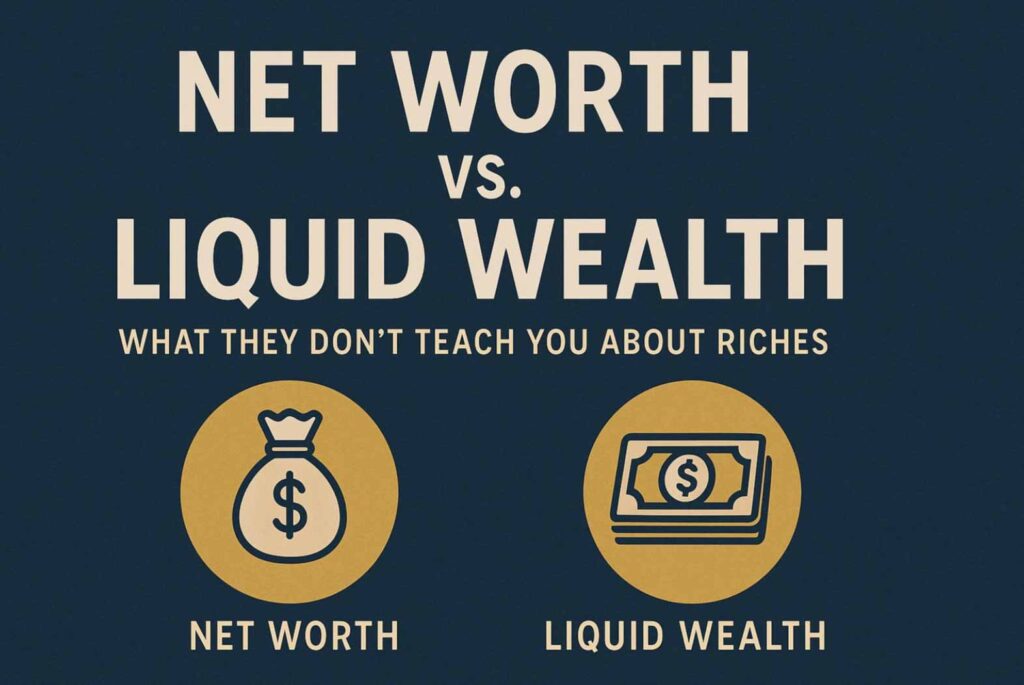
Net Worth vs. Liquid Wealth: What They Don’t Teach You About Riches

 When people talk about “richness,” they often think in terms of net worth – the dollar value of everything someone owns minus what they owe. We hear headlines like “Person X has a $300 billion net worth” and assume those billions translate into bank accounts or stacks of cash. But in reality, net worth and liquid wealth (sometimes called liquid net worth) can be very different. Net worth includes all assets – real estate, retirement accounts, businesses, collectibles, etc. – whereas liquid wealth counts only the assets you can quickly convert to cash (like checking accounts, stocks, bonds, and other marketable securities). In practice, that means a billionaire might be astronomically rich on paper yet have very little cash immediately available, while an everyday family might own a home (high net worth) but have almost no savings for an emergency.

This article explains these two measures of wealth in depth, why they’re often confused, and why focusing only on net worth can be misleading. We’ll explore how different asset types – houses, stocks, retirement funds, business ownership and more – contribute to one’s net worth but not to liquid wealth. We’ll use concrete examples, from ordinary households to famous billionaires and major companies, to show how net worth and liquid wealth can diverge dramatically. Finally, we’ll discuss why liquidity matters: how having (or lacking) accessible cash can shape financial decisions, emergency preparedness, and outcomes in market downturns.

Net Worth vs. Liquid Wealth: What They Don’t Teach You About Riches

Our goal is clarity and thoroughness. Let’s start by defining the terms.

What is Net Worth?

Net worth is the most common measure of personal or corporate wealth: it’s simply assets minus liabilities. In other words, take everything you own that has monetary value, then subtract everything you owe. For an individual, assets include things like a home, investment accounts, retirement accounts (401(k), IRAs), cars or other vehicles, and personal valuables. Liabilities include mortgages, car loans, credit card debt, student loans, and any other debts. Mathematically:

Net Worth = (All Assets) – (All Liabilities)

This is exactly how financial websites and experts define it. For example, a recent Investopedia guide explains that net worth is calculated by “adding up the total value of your assets and subtracting your debts, [arriving] at a single number that reflects your overall financial position”. In practical terms, if you own a $750,000 house, $50,000 in cars, $100,000 in investments, and owe $650,000 on your mortgage plus $20,000 in other debt, your net worth would be $230,000.

Net worth can be positive or negative. If your debts exceed your assets, you have negative net worth (e.g. having $100k in debts and only $50k in assets means –$50k net worth). Net worth is a snapshot of financial health at a point in time. It is widely used to track wealth over time (people often check their net worth quarterly or annually) and even to compare wealth. The ultra-rich themselves and the media often talk about net worth – for example, Forbes publishes a “Billionaires List” based on estimated net worth. As Investopedia notes, net worth is “commonly used to measure how much a company or a public figure is worth”. Families or individuals similarly might calculate net worth to see if they are building wealth over the years.

Assets in net worth: Typical categories include real estate (your home, rental properties, land), retirement accounts (401(k), pension plans, IRAs), investment accounts (stocks, bonds, mutual funds, crypto), business ownership stakes, and personal property (vehicles, jewelry, collectibles). For example, credit reporting will often include the market values of these assets. Importantly, all assets count, regardless of how easily they can be sold.

Liabilities in net worth: These are all debts and obligations. Common examples are mortgages, student loans, car loans, credit card balances, and any personal loans. These reduce your net worth because they are amounts you owe.

As an example, a young family might have:

  • Home worth $300,000 with a $250,000 mortgage (so $50,000 equity in home),
  • Retirement accounts of $100,000,
  • Investment accounts (stocks/bonds) worth $20,000,
  • A car worth $15,000 with $5,000 left on the loan,
  • $10,000 total in other loans and credit card balances.

Their net worth would be: (300k + 100k + 20k + 15k) – (250k + 5k + 10k) = $280,000 – $265,000 = $15,000.

Because it includes home equity and retirement savings, this net worth is positive. However, it doesn’t tell you how much cash this family actually has on hand – that is a separate calculation we’ll do next.

What is Liquid Wealth?

Liquid wealth (or liquid net worth) is a narrower measure: it counts only the assets that can be quickly converted into cash. In other words, it represents how much money you could immediately access to handle an emergency or opportunity. The simplest way to think of it: liquid wealth is what’s ready to spend, net of any debts.

Formally, one can compute it similarly to net worth, but include only liquid assets (and still subtract all liabilities). The formula is:

Liquid Wealth = (All Liquid Assets) – (All Liabilities)

However, typically when people use “liquid wealth” they often just mean the total liquid assets (because liabilities are usually less relevant in emergency planning; we can note them but focus on assets).

What counts as liquid assets? The key is quick convertibility into cash with minimal loss. Examples include:

  • Cash itself: physical cash or checks you could deposit.
  • Bank accounts: Checking and savings accounts (funds in these accounts are on hand).
  • Money market accounts or funds: These are cash-like accounts that are highly liquid.
  • Certificates of deposit (CDs) nearing maturity: If a CD is about to mature, it’s effectively like cash.
  • Stocks, bonds, ETFs and mutual funds: Shares of publicly traded companies or funds can be sold on the market (though their value may fluctuate, they are generally liquid in the sense that you can sell them quickly at market price).
  • Short-term government securities: Treasury bills and similar short-term investments.

In contrast, non-liquid (illiquid) assets – which count for net worth but not liquid wealth – include:

  • Real estate: Your home or land. To convert this to cash you would have to sell or take out a mortgage, which can take months.
  • Retirement accounts: 401(k)s, IRAs, pensions, etc. Technically these have value, but early withdrawals often incur penalties or taxes, and they are designed for long-term savings.
  • Private business ownership: Shares in a private company or your own business equity. Unless the business is sold or goes public, you can’t easily cash out.
  • Collectibles & personal property: Art, jewelry, antiques, cars beyond everyday vehicles – these can be hard to sell quickly or their selling price might not be easily determined.
  • Unvested stock options or restricted shares: Even if granted in a company, these typically cannot be sold until certain conditions are met.

A helpful way to see this distinction is given by a financial guide, which lists liquid assets as cash, checking/savings accounts, CDs near maturity, brokerage accounts with stocks/bonds, and money market accounts. It then contrasts non-liquid assets as real estate, retirement accounts with penalties, private business stakes, collectibles, and personal property.

In plain terms: liquid wealth is essentially your “cash plus near-cash” value minus debts, while net worth is everything. Liquid wealth shows your financial flexibility. As one source puts it, “liquid net worth narrows the focus to assets that can be quickly converted into cash, showing how financially flexible you are in the short term”. It’s basically the money you could tap immediately – without selling a house or breaking into your retirement fund.

For example, consider a retiree who owns a home worth $500k, has a $300k mortgage (so $200k in home equity), $100k in a 401(k), $50k in an investment portfolio, $10k in the bank, and owes $10k on a credit card. Their net worth is $ (500k + 100k + 50k) – (300k + 10k) = $340k. But their liquid wealth is much lower: only $10k in the bank plus (if they count their investment portfolio of $50k as easily sellable) makes $60k of liquid assets, minus $10k debt = $50k liquid net worth. The house and retirement funds ($500k + $100k in value) don’t immediately help them pay an unexpected medical bill.

It’s often quoted that many people are “asset-rich but cash-poor.” That means they have significant net worth on paper, but most of it is tied up in illiquid assets. Financial experts warn that this is an important distinction. As one guide explains, “the key feature of liquid net worth is that it includes only assets that can quickly be converted into cash… making liquid net worth a better indicator of emergency preparedness”. In other words, if you want to know how well you can weather a sudden expense or loss of income, liquid wealth (cash + near-cash) is a more relevant measure than total net worth.

A government report similarly notes that “liquid assets help families stay afloat when faced with unexpected expenses or financial turmoil”. It defines liquid wealth as assets that can be turned into cash quickly (like checking/savings, stocks, bonds) and contrasts this with retirement accounts or home equity that “takes more time and may be more difficult to turn into cash”.

In summary, remember: Net worth = all wealth; Liquid wealth = only readily available wealth. One is a broad snapshot, the other is your accessible “rainy-day fund.” Both are useful, but they tell very different stories.

Why These Terms Are Often Confused

Given these definitions, why do people mix them up? In casual conversation and even some media, “wealth” and “net worth” are often used interchangeably with “money on hand” or “cash.” It’s tempting to think that if someone’s net worth is $100 million, then they must have $100 million in their pocket. That’s simply not the case for most people, and especially not for the ultra-wealthy.

Part of the confusion comes from social media and news reports. When a celebrity or CEO “becomes a billionaire” or “loses billions,” that refers to net worth estimates (often based on stock prices), not actual cash transactions. People hear “Bill Gates is worth $120B” and imagine stacks of $100 bills, but in truth a large portion is in stock of Microsoft, or other assets. Net worth gets a lot of attention — after all, Forbes compiles lists of the richest people in the world based on it. But these lists really describe paper wealth, not liquidity.

Financial advisers stress the difference. As one expert writes, “net worth tracks what you own versus what you owe, while liquid net worth shows how much of that wealth is readily available”. When asked, even many wealthy individuals will point out that their net worth is not cash. For instance, tech billionaire Elon Musk (whose net worth has been as high as $500 billion) has referred to himself as “cash poor” because most of his wealth is in Tesla stock and other assets. Media outlets reported that at one point Musk had “the majority of his fortune tied up in Tesla stock” and joked that he doesn’t have millions in liquid cash to pay personal expenses. Similarly, Jeff Bezos’s fortune comes mostly from Amazon stock; financial reports indicate that as of early 2023 Bezos had roughly $96 billion in Amazon and other public holdings, but only around $12.7 billion in cash and private assets (about 10–15% of his wealth).

Part of the confusion also arises because financial education often doesn’t emphasize liquidity. We learn to save and invest, building assets, but rarely are we taught to distinguish where our wealth is. The idea of maintaining emergency savings (“liquid assets”) is talked about, but the stark difference between net worth and liquid worth is not a common lesson. Advertisements and lifestyle portrayals may even blur them: someone flaunting a luxury home or private jet could be seen as rich, but without liquid resources, they might struggle with an unexpected expense.

In essence, the two terms get muddled because people speak of “rich” in broad terms. It’s crucial to clarify: having a high net worth does not automatically mean having lots of cash ready to spend.

The Perils of Focusing Only on Net Worth

Why does this distinction matter? Because net worth can be a misleading indicator of financial health if taken alone. Here are some key pitfalls:

  • Illusory Wealth. A high net worth can mask poor liquidity. For example, a homeowner with $500k in home equity might feel wealthy, but that equity isn’t usable day-to-day. As one personal finance article warns, “a high net worth isn’t necessarily a sign of financial freedom. For example, a home’s equity can inflate net worth but isn’t easily accessible for everyday expenses.”. In other words, a beautiful mansion or expensive car adds to net worth, but if you needed $10,000 tomorrow, you couldn’t just withdraw it from the house.
  • Market Volatility and Instability. Net worth that relies heavily on volatile assets (like stock) can swing wildly with the market. This can lead to stress and poor decisions. In late 2022, Elon Musk’s net worth famously plunged by about $200 billion in one day when Tesla’s stock fell. Such a drop in “paper wealth” could tempt someone to panic-sell holdings, even if their long-term financial plan didn’t change. Indeed, financial advisors caution that obsessing over net worth can lead to “focusing on immediate gains or losses, potentially leading to impulsive decisions”. If you fixate on the dollar value of your portfolio, a temporary market dip might make you do the wrong thing (like selling low and buying high).
  • Lack of Emergency Funds. Someone might have high net worth but still struggle to handle a crisis. For instance, a retiree could have a $400,000 home and $500,000 in 401(k), but if all their cash is tied up, a sudden medical bill or home repair could force them into debt. Without enough liquid wealth, people often resort to credit cards or loans when surprises hit. Research finds that when prices rise or incomes drop, lower-income families in particular “have been forced to dip into their savings or increase their debt just to maintain their standard of living”. In practical terms, a middle-class family might appear to have decent net worth (due to home equity and retirement accounts) but have only a few thousand dollars of savings. An emergency in that situation could trigger high-interest borrowing or asset sales.
  • Short-Term Thinking & Stress. Obsession with net worth can encourage short-term thinking. If one’s goal is simply “increase net worth,” one might ignore crucial expenses or liquid reserves. MoneyTalksNews warns that fixating on net worth might “lead to neglecting lifestyle goals or experiences that bring joy” in favor of acquiring assets. Or worse, it might encourage hoarding cash excessively at the expense of, say, health or family needs (though hoarding cash can also backfire in inflationary times). The key message experts give is to keep perspective: net worth is just one metric among many.

In summary, relying only on net worth can give a false sense of security. It can mask liquidity problems and leave people unprepared for real-world needs. As one finance article concludes, “tracking your net worth is a helpful practice, but it’s only part of the story… wealth isn’t just about numbers—it’s about creating a life that aligns with your values and priorities.”. Indeed, someone with $1 million net worth but no accessible cash may struggle more than someone with $500,000 net worth who has a large emergency fund and stable income.

Examples: The Wealthy and the Rest — Gaps Between Net Worth and Cash

Let’s look at specific examples to illustrate the gap between net worth and liquid wealth. We’ll start with well-known billionaires, then consider average people, and also examine major companies.

Elon Musk – Astronomically High Net Worth, “Cash Poor”

Elon Musk has become famous not just for electric cars but for his wealth. Around 2021–2022, Musk’s net worth skyrocketed past $300–$400 billion, making him the richest person on Earth. Yet Musk himself has repeatedly pointed out that this doesn’t mean he has dollars in the bank. According to his Wikipedia profile, he “repeatedly described himself as ‘cash poor’ and has ‘little interest in material trappings of wealth’”. In concrete terms, most of Musk’s fortune is tied up in Tesla stock (about 75% as of 2020) and other ventures, which are not easily sold without affecting the market.

This lack of liquidity has real consequences. For example, Musk has commented that even though he’s worth hundreds of billions, he doesn’t readily have millions in cash. Indeed, in early 2022 he needed to sell billions of dollars in Tesla shares – facing the very visible task of paying $11 billion in taxes – because he had promised large stock-based compensation and funding obligations to the IRS. Then in late 2022, Tesla’s stock dipped and Musk lost roughly $200 billion of his net worth in one day. It’s instructive: Musk still doesn’t have an extra $200B in cash to flush, so this was a paper loss. If even he, with enormous wealth, can say he’s “cash poor,” imagine how it is for most people.

This example underscores the point: Musk’s net worth is colossal, but his liquid wealth – the cash and immediately cash-convertible investments he has on hand – is only a tiny fraction of that. His liquidity depends on selling stock, which itself would move markets if he sold too much. This gap is exactly why many news stories describe billionaires as “paper rich, cash poor.” Musk’s situation teaches us that net worth alone doesn’t capture financial reality.

Jeff Bezos – Billions in Stock, Limited Cash

Jeff Bezos, founder of Amazon, is another instructive case. At his peak, Bezos’s net worth has exceeded $200–$130 billion (depending on stock prices). Like Musk, most of Bezos’s wealth is in company stock. A Bloomberg report summarized that Bezos’s net worth (roughly $121 billion in early 2023) breaks down into about $96.5 billion in public assets (Amazon and others), $11.2 billion in private ventures, and only about $12.7 billion in cash and readily-sellable assets. That means only around 10% of his net worth was in liquid form at that time.

Why does that matter? For one, it shows that despite being the world’s richest person, Bezos only keeps billions (not hundreds) in the bank. Indeed, reports indicated he sells roughly $1 billion of Amazon stock each year to fund his space company Blue Origin. If Bezos needed $5 billion quickly, he would have to liquidate stock or borrow against it, because he doesn’t sit on petabytes of cash. (For context, $5 billion is less than 5% of his net worth but would triple his cash holdings.)

So Bezos’s case is similar: net worth skyrockets with stock price, but liquid wealth (cash) grows more modestly. It also shows why even very wealthy people maintain cash reserves: it’s to have accessible funds for projects and emergencies. Smart money advice often says keep some cash for opportunities; Bezos’s $10–12 billion cash reflects that principle, even for a multibillionaire.

Everyday Households – The Asset-Rich, Cash-Poor Reality

We see the gap between net worth and liquid wealth not only in billionaires, but in average families too. Consider a typical middle-class American household: most of their net worth comes from their home equity and retirement accounts. They might have a net worth of $500,000 once the family home (say $400k value minus $200k mortgage) and 401(k) (say $100k) are added together. But how much accessible cash do they have? Possibly only a few thousand dollars in checking and savings combined. If that household lost income, they couldn’t cover expenses for long without borrowing.

Statistics back this up. According to a study by WorkRise, nearly all families own some form of liquid assets (like savings or stocks), but the median amount was very low. In 2022 the typical white family had about $15,000 in liquid assets while the typical Black family had only about $2,130. Furthermore, only 90% of white families (and 77% of Black families) could cover a $400 emergency expense with savings. That means a significant share of households, despite having significant net worth in homes or retirement, lack enough liquid cash for even modest emergencies.

In plain language, many people are house-rich but cash-poor. For example, if your home price has doubled since purchase, your net worth is much higher – but unless you’ve been selling or refinancing, that extra equity isn’t sitting in your bank. Similarly, a steady stream of retirement contributions can build a large 401(k), raising net worth, but you can’t touch it without penalty until retirement age.

When incomes shrink or costs rise, low liquidity can cause real hardship. A Federal Reserve report notes that about half of U.S. adults don’t have enough savings to cover a $400 emergency (requiring them to borrow or sell something). And the WorkRise report mentioned above found that as prices climbed in 2022, lower-income households “have been forced to dip into their savings or increase their debt just to maintain their standard of living.”. In contrast, wealthier families often preserved or even increased their liquid assets during the same period.

Thus, even ordinary people with decent net worth by American standards can feel poor on cash. A homeowner with $200k equity and $50k in 401(k) might have an $80k+ net worth, but if their checking account has $500, they are essentially living paycheck to paycheck.

Companies – Market Value vs Cash on Hand

The net worth/liquidity gap also appears at the corporate level when we look at market capitalization (a rough analog of company net worth) versus cash reserves. Consider big tech companies:

  • Tesla, Inc. has had a staggering market cap (over $1.4 trillion in 2025), making it one of the world’s most valuable companies. Yet Tesla’s cash and equivalents on its balance sheet is tiny by comparison – roughly $41.6 billion as of Q3 2025. That means Tesla’s market value is more than 30 times its cash holdings. For Musk, whose stake makes up most of his net worth, the company’s huge valuation doesn’t mean tens of billions of extra cash.
  • Apple Inc. is the world’s largest company by market cap (about $3.9 trillion in late 2025). Its cash on hand was around $55 billion in mid-2025 (only about 1–2% of its market cap). Again, this shows Apple’s “net worth” (if one used market cap as a proxy) vastly exceeds its liquid pile, even though Apple is known for hoarding cash.
  • Berkshire Hathaway is an outlier. Warren Buffett’s conglomerate famously held enormous cash reserves. As of 2023/2024, Berkshire’s cash pile exceeded $300 billion – reportedly the largest cash hoard of any public company, even more than Apple, Microsoft, Alphabet, Amazon, and Nvidia combined. Berkshire’s market cap is around $700–800 billion, so its cash made up roughly 40–50% of its value at that point. This was a deliberate strategy by Buffett to keep liquidity ready for opportunities.

These corporate examples highlight that market valuation (like net worth for an individual) can diverge greatly from cash liquidity. A company might be worth hundreds of billions, but if it only has a few billion liquid, it can’t suddenly spend that valuation. Conversely, Berkshire shows that having lots of liquid assets can be a strategic choice.

How Different Assets Affect Net Worth and Liquidity

To understand why net worth and liquid wealth often differ, let’s consider various asset classes and how they contribute to each measure:

  • Real Estate (Home Equity, Land, Rentals). For most Americans, the largest single asset is their home. Home equity counts fully toward net worth. If you own a house worth $300k with a $100k mortgage, that $200k equity adds to your net worth. However, it does not count as liquid wealth unless you borrow against it or sell the house. Since selling can take months and may incur fees (and borrowing adds liabilities), real estate is generally illiquid. As noted earlier, home equity can greatly inflate net worth but isn’t readily spendable.
  • Retirement Accounts (401(k), IRA, Pension, etc.). These are often the largest portion of middle-class wealth. By law, you usually cannot withdraw from a 401(k) or IRA before age 59½ without a 10% penalty (and taxes), so these funds are effectively illiquid until retirement (unless you accept penalties). Still, they count 100% toward net worth (their current balance minus any loans taken out). They do not count in liquid wealth except for perhaps small allowable withdrawals. For example, a $500k 401(k) adds $500k to net worth but $0 to immediate cash.
  • Investments (Stocks, Bonds, Mutual Funds, ETFs). Publicly traded securities occupy a gray area. They are liquid in that you can sell them quickly through a brokerage (usually receiving funds within a few days). But their value can fluctuate daily, so they are not as stable as cash. By most definitions, however, they are considered liquid assets. Thus, the total value of your brokerage account contributes both to net worth and to liquid wealth. (Exception: some “illiquid” securities like privately held stock or restricted shares do not count until converted to market-traded shares.)It’s worth noting that liquid wealth is often measured at current market value of these holdings. For instance, if you own $10,000 of stock in Company X, that $10k counts as part of your liquid assets (since you could sell it). If the market crashes and that stock value drops to $5,000, your net worth and liquid wealth both fall by $5,000. This ties you into market risk, but on the plus side you do have flexibility to sell when needed.
  • Private Business Equity. If you own a business or shares in a privately held company (e.g. stock options in a startup), that’s usually considered illiquid. You would include its estimated value in net worth, but it contributes nothing to liquid wealth until an exit event (sale, IPO, etc.). Many entrepreneurs’ net worth is tied to their company’s estimated worth on paper, but they often have very little liquid money early on. For example, a startup founder might have $10 million in equity when the company is valued that high, but if it’s not sold, they can’t draw $10 million out of the business immediately.
  • Personal Property and Collectibles. Items like cars (beyond everyday drivers), art, jewelry, and other valuables count in net worth. A vintage car worth $200,000 or a painting worth $1 million adds to net worth. However, selling these can be slow and uncertain (and values can be subjective), so they’re generally considered illiquid. If a car is an everyday vehicle, it might be semi-liquid (you could sell on short notice), but high-end luxury items are not easily cashed.
  • Cash and Bank Accounts. This one is straightforward: actual cash and funds in checking/savings accounts are fully counted in both net worth and liquid wealth. They are 100% liquid by definition (except any FDIC limits or immediate withdrawal terms, but practically they’re accessible).

To sum up: anything that requires time or penalty to convert to spending money is in net worth but not liquid wealth. A useful guide puts it like this: “net worth includes all assets, both liquid and illiquid, such as real estate, retirement accounts and personal property”. Meanwhile, “liquid net worth paints a clearer picture of how debt compares to the cash and investments you can actually access in the short term”.

Here’s a bullet-point recap of typical asset types, indicating which side they fall on:

  • Liquid Assets (count in liquid wealth):
    • Cash (currency)
    • Checking & savings accounts
    • Money market funds/accounts
    • Certificates of Deposit (CDs) near maturity
    • Publicly traded stocks and bonds (brokers can sell in days)
    • Mutual funds / ETFs (traded on markets)
  • Illiquid Assets (count in net worth only):
    • Primary residence and other real estate (homes, land)
    • Retirement accounts (401(k), IRA, pension funds)
    • Private business ownership/equity
    • Collectibles, art, jewelry, classic cars
    • Long-term assets like annuities or locked-in life policies (unless borrowed against)

Understanding how each category flows into net worth vs liquid wealth helps explain why someone might be “asset rich but cash poor.” It also clarifies financial planning: when building wealth, you often invest in illiquid assets (like buying a home or saving for retirement), but you also need a separate cash buffer for emergencies.

Liquidity and Financial Decision-Making

Having a handle on your liquid wealth isn’t just academic; it influences real decisions and resilience. Liquidity – the ability to quickly access cash – can shape everything from daily budgeting to responding to crises.

  • Emergency Preparedness. The classic rule of personal finance is to have an emergency fund (commonly 3–6 months of living expenses) in a liquid form. If you have only illiquid wealth (like your house and retirement), a sudden job loss or medical emergency can be catastrophic. For example, during a period of rising prices or lost income, families with very little liquid savings may need to take out high-interest credit cards or loans. As noted earlier, studies found lower-income households “were forced to dip into their savings or increase their debt just to maintain their standard of living” when inflation rose. In contrast, households with a cushion of liquid assets can cover expenses without resorting to costly borrowing.
  • Opportunity Cost and Investment Flexibility. On the positive side, holding liquid wealth gives you the flexibility to seize opportunities. If the stock market dips and you have cash, you can buy more shares at a discount. If a business opportunity arises, you have immediate funding. Conversely, with low liquidity, you might miss such chances or have to sell other assets (which could have tax or penalty costs). For companies, this is seen in Berkshire Hathaway’s strategy: Warren Buffett keeps a huge cash reserve so he can pounce on acquisitions or investments when valuations drop. For individuals, having savings means not being “all in” on illiquid assets.
  • Market Downturns and Crises. When financial markets crash or a recession hits, liquidity becomes critical. Those with large liquid wealth can withstand temporary shocks. For example, during the COVID-19 pandemic, businesses with strong cash reserves survived shutdowns more easily; similarly, investors with cash avoided panic selling. For regular people, think of the 2008 housing crash: many were “house rich, cash poor,” meaning their home values were high on paper but they didn’t have enough cash for mortgage payments after job losses. The result was foreclosure despite seemingly good net worth.
  • Personal Life Events. Major life events – buying a home, starting a family, medical bills, education – all require cash flow. Even taking a business loan or mortgage depends on your liquid ability to make payments. If someone’s net worth is high but locked in stock or retirement, they may find it hard to qualify for credit or down payments. Lenders and insurers often look at liquidity as well as net worth.

Given these points, experts advise that net worth and liquid wealth should be used together to gauge financial health. SmartAsset (a financial guidance site) emphasizes that “looking at both net worth and liquid net worth provides a more complete picture of your financial health than relying on either number alone.”. In other words, track both your long-term wealth and your liquid safety net.

In practical terms, that means not just aiming to maximize net worth at all costs, but also ensuring you have an emergency fund and accessible cash. It may mean periodically converting some illiquid assets to liquid ones (for example, shifting a portion of investments into cash or short-term bonds) so that you can meet short-term needs.

Balancing Long-Term Wealth and Short-Term Flexibility

The key lesson is balance. Neither metric (net worth or liquid wealth) alone tells the whole story:

  • Net worth is vital for long-term goals – retirement planning, homeownership, legacy building. It shows if you’re accumulating assets and reducing debt over decades. Watching net worth over time (year to year) shows if you’re truly growing richer.
  • Liquid wealth is vital for immediate needs and flexibility – covering emergencies, eliminating high-interest debt, and having freedom in decisions. It shows if you can handle shocks without breaking the bank or selling essentials.

Just as financial advisors encourage looking at multiple indicators (cash flow, savings rate, debt ratios), combining net worth and liquidity gives fuller insight. For example, someone might have a high net worth but low cashflow, while another might have moderate net worth but steady income and savings – their situations are very different. A Forbes analysis even suggests comparing liquid wealth to debts to gauge stability.

Practical tip (no formal citation needed): A healthy financial strategy is to always keep some liquid reserves. Many planners say maintain an emergency fund (3–6 months expenses) in cash or equivalents. Then invest or save the rest for growth. Remember that just because your net worth is large, don’t treat it as if it’s cash.

In crises or decision-making, it often boils down to liquidity. If you lose your job, can you live off savings? If you see a once-in-a-lifetime opportunity, can you take it without selling your retirement? If interest rates rise, can you pay new bills? Monitoring liquid net worth answers these questions.

Why Liquid Wealth Matters Most

In summary, net worth and liquid wealth are both important, but they measure different aspects of financial life. Net worth captures your overall accumulation of assets (and debts) – it’s the figure often quoted in wealth rankings and retirement planning. Liquid wealth captures your accessible cash and near-cash, reflecting day-to-day financial flexibility. It’s the money that actually lives in your wallet, bank, or brokerage, ready for use.

These concepts often get conflated, but they shouldn’t be. A person can be extremely “rich” in net worth yet have very little spending power at any given moment (as we saw with billionaire examples). Conversely, someone might not be a billionaire but may live comfortably if they have sufficient liquid assets relative to their needs.

We hope this article clarifies the nuances. The “riches” that schools and popular discussions often skip over are exactly this: the liquidity component of wealth. By understanding both, you gain a more realistic picture of financial health. Track your net worth to gauge long-term progress, and track your liquid wealth to ensure short-term stability. In doing so, you’ll have the truest understanding of “being rich” – not just on paper, but in life.


Blog provided by our friends at AuditingAccounting.com